


Page 574 - The Book of Caterpillars: A Life-Size Guide to Six Hundred Species From Around the World
P. 574
MOTH CATERPILLARS

                                                     FAMILY  Erebidae
                                                 DISTRIBUTION  North America, Europe, and across northern Asia
                                                    HABITAT  Woodlands, hedgerows, parks, and gardens
                                                  HOST PLANTS  Various tree species, including oak (Quercus spp.),
                                                          willow (Salix spp.), and poplar (Populus spp.)
                                                      NOTE  Bizarre-looking, tufty caterpillar with irritating hairs
                                             CONSERVATION STATUS  Not evaluated


            ADULT WINGSPAN


           1–1⅜ in (25–35 mm)
           CATERPILLAR LENGTH

           1⅜– 1 ⁄   in (35–40 mm)

                                                                              ORGYIA ANTIQUA
                                                     RUSTY TUSSOCK MOTH
    572
                                                                                   (LINNAEUS, 1758)


                                            Unusually, the female Rusty Tussock Moth is  ightless, so she
                                            lays her large clutch of 200 to 300 eggs on her empty cocoon.
                                            The eggs overwinter, and the caterpillars emerge in spring. The
                                            caterpillars are active between May and September, feeding on
                                            a variety of deciduous species. The hairy young larvae disperse
                                            by ballooning on threads of silk. They pupate in crevices in
                                            bark or on fences, spinning a black, hairy cocoon. The adult
                                            moths eclose from July to October. There are usually one or two
                                            generations, but in some places there are three a year.


                                            The Rusty Tussock Moth, also named the Vapourer, has a wide
                                            distribution across the northern hemisphere. The caterpillar
                                            is considered a pest, as large aggregations on trees can lead to
                                            defoliation and damage to parkland and orchard trees. If the
                                            caterpillar is handled without gloves, its hairs, which detach
                                            easily, can cause skin irritation.


                      Actual size

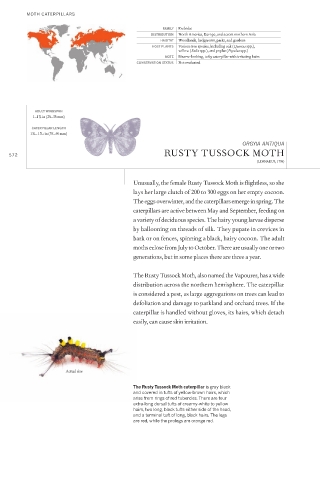
                                            The Rusty Tussock Moth caterpillar is gray black
                                            and covered in tufts of yellow-brown hairs, which
                                            arise from rings of red tubercles. There are four
                                            extra-long dorsal tufts of creamy-white to yellow
                                            hairs, two long, black tufts either side of the head,
                                            and a terminal tuft of long, black hairs. The legs
                                            are red, while the prolegs are orange red.

