


Page 566 - The Book of Caterpillars: A Life-Size Guide to Six Hundred Species From Around the World
P. 566
MOTH CATERPILLARS

                                                     FAMILY  Erebidae
                                                 DISTRIBUTION  Western and eastern areas of North America, Europe, North
                                                          Africa, western and central Asia, Russian Far East, and Japan
                                                    HABITAT  Woodland edges and hedgerows, parks, and gardens
                                                  HOST PLANTS  Deciduous trees, including willow (Salix spp.) and poplar
                                                          (Populus spp.)
                                                      NOTE  Widely distributed and destructive caterpillar
                                             CONSERVATION STATUS  Not evaluated, but widespread and common


            ADULT WINGSPAN
           1

–2 in (37–50 mm)
           CATERPILLAR LENGTH
           1	  –1¾ in (35–45 mm)
                                                                              LEUCOMA SALICIS
                                                           WHITE SATIN MOTH
    564
                                                                                   (LINNAEUS, 1758)


                                            The female White Satin Moth lays eggs in clusters on tree trunks
                                            and covers them in a white froth. The caterpillars hatch and feed
                                            for a few weeks before overwintering in a silken web. The larvae
                                            then emerge the following spring, start feeding again, and by
                                            midsummer are ready to pupate. They then spin a loose cocoon,
                                            which they attach to almost any surface. As well as defoliating
                                            trees, the caterpillars wander widely in their search for food or
                                            a place to spin their loose cocoon, often within rolled leaves. The
                                            pupa is glossy black with tufts of hair.


                                            The caterpillar is a major forest pest as it defoliates vast swathes
                                            of deciduous forest, especially in North America, where, since
                                            its arrival in the 1920s, it has spread across the continent.
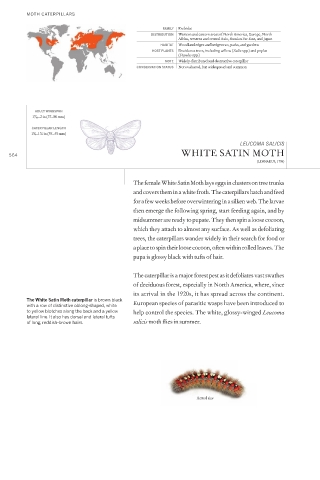
          The White Satin Moth caterpillar is brown black   European species of parasitic wasps have been introduced to
          with a row of distinctive oblong-shaped, white
          to yellow blotches along the back and a yellow   help control the species. The white, glossy-winged Leucoma
          lateral line. It also has dorsal and lateral tufts

          of long, reddish-brown hairs.     salicis moth  ies in summer.


                                                                Actual size

