


Page 615 - The Book of Caterpillars: A Life-Size Guide to Six Hundred Species From Around the World
P. 615
MOTH CATERPILLARS

                      FAMILY  Noctuidae
                  DISTRIBUTION  North America, from southeastern Canada to Florida,
                           west to Texas
                     HABITAT  Woodlands and forest edges
                  HOST PLANTS  Porcelainberry (Ampelopsis spp.), Virginia Creeper (Parthenocissus
                           quinquefolia), and grapevine (Vitis spp.)
                      NOTE  Caterpillar that rests and feeds exposed, usually on young foliage
             CONSERVATION STATUS  Not evaluated, but relatively uncommon


                                                                                   ADULT WINGSPAN


                                                                                 1⅜–1  ⁄   in (35–46 mm)
                                                                                  CATERPILLAR LENGTH
                                                                                    1 ⁄   in (40 mm)
            EUDRYAS GRATA
            BEAUTIFUL WOOD NYMPH                                                                 613

            (FABRICIUS, 1793)


            The Beautiful Wood Nymph caterpillar feeds and rests in plain
            sight, suggesting probable toxicity to predators. One generation
            is typical in its northern range, with two or more possible farther
            south. Larvae occasionally rest on wood structures such as fence
            posts or park benches, lending credence to the common name.
            At pupation, the caterpillar digs into bark or stems, parts of
            which it uses to construct its cocoon. The pupa overwinters,
            and the moth ecloses in early summer.


            The caterpillar is relatively uncommon throughout its range
            and usually happened upon while searching for something else.

            At  rst glance, Eudryas grata larvae are almost indistinguishable
            from those of the closely related Pearly Wood Nymph (E. unio),
            although there is a subtle difference in the prolegs: E. grata
            has a single black basal spot, while E. unio has two. Adults of
            both species also look strikingly similar—both are convincing
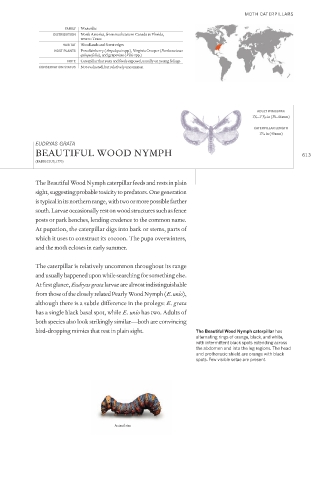
            bird-dropping mimics that rest in plain sight.      The Beautiful Wood Nymph caterpillar has
                                                                alternating rings of orange, black, and white,
                                                                with intermittent black spots extending across
                                                                the abdomen and into the leg regions. The head
                                                                and prothoracic shield are orange with black
                                                                spots. Few visible setae are present.


                                      Actual size

