


Page 611 - The Book of Caterpillars: A Life-Size Guide to Six Hundred Species From Around the World
P. 611
MOTH CATERPILLARS

                      FAMILY  Noctuidae
                  DISTRIBUTION  Southern Europe (from Spain to the Balkans), north to United
                           Kingdom and Denmark, east to the Caspian Sea, the Middle East,
                           Macaronesia, Africa, and Madagascar
                     HABITAT  Farmlands, gardens, and other open places with herbaceous plants
                  HOST PLANTS  Cruciferous vegetables (Brassica spp.) and other Fabaceae,
                           Common Nettle (Urtica dioica), bean (Phaseolus spp.),
                           pelargonium (Pelargonium spp.), Tomato (Solanum lycopersicum),
                           and chrysanthemum (Chrysanthemum spp.)
                      NOTE  Widespread, semi-looper caterpillar that is a tropical crop pest
             CONSERVATION STATUS  Not evaluated, but common or abundant throughout most of
                           the range


                                                                                   ADULT WINGSPAN
                                                                                  1¼–1¾ in (32–44 mm)
                                                                                  CATERPILLAR LENGTH
                                                                                  1 ⁄  –1½ in (34–38 mm)
            CHRYSODEIXIS CHALCITES
            GOLDEN TWIN-SPOT                                                                     609

            (ESPER, 1789 )


            The Golden Twin-spot caterpillar hatches from a greenish-
            white, domed egg laid singly on a leaf. When very small, the
            larva is green with scattered black spots, each with a short,

            dark hair. At  rst, it grazes the underside of the leaf, creating
            translucent windows, and if disturbed drops down on a silk
            thread. When larger, the caterpillar eats all or most of the leaf
            and excavates fruit and unripe seedpods, but without burrowing
            inside. It forms a black-and-green pupa in a white cocoon, often
            spun under a leaf. The species can breed continuously with up
            to nine generations annually.


            Like other members of its subfamily Plusiinae, the Golden
            Twin-spot caterpillar walks rather like an inchworm or looper
            caterpillar (family Geometridae). The body shape, tapering
            from back to front, is also a characteristic of the group. The
            caterpillar is a major crop pest in Africa, the Middle East, and
            southern Europe. Adults migrate farther north, sometimes
            imported with produce, and occur as pests in glasshouses.


                                                                            Actual size

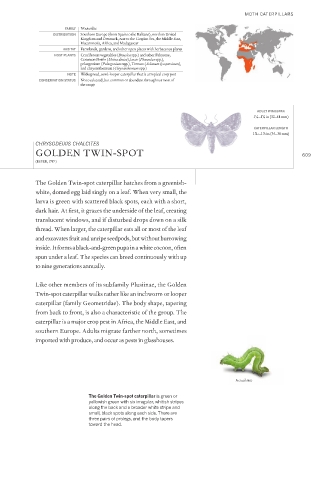
                             The Golden Twin-spot caterpillar is green or
                             yellowish green with six irregular, whitish stripes
                             along the back and a broader white stripe and
                             small, black spots along each side. There are
                             three pairs of prolegs, and the body tapers
                             toward the head.

