


Page 617 - The Book of Caterpillars: A Life-Size Guide to Six Hundred Species From Around the World
P. 617
MOTH CATERPILLARS

                      FAMILY  Noctuidae
                  DISTRIBUTION  Europe, from Iberia, southern England, and southern Scandinavia
                           across Russia and southern Siberia to Sakhalin Island; Morocco
                           and Algeria, the Middle East, and across western and central Asia
                           to northern China and Japan
                     HABITAT  Warm, open, dry habitats, including gardens
                  HOST PLANTS  Carnation (Dianthus caryophyllus), Sweet-william (Dianthus
                           barbatus), and pinks (Dianthus spp.); also campion (Silene spp.),
                           including Bladder Campion (Silene vulgaris)

                      NOTE  Caterpillar that hatches among  ower heads, hiding elsewhere
                           when larger
             CONSERVATION STATUS  Not evaluated


                                                                                   ADULT WINGSPAN
                                                                                  ⅞–1 ⁄   in (22–30 mm)
                                                                                  CATERPILLAR LENGTH
                                                                                  1 ⁄  –1 ⁄   in (30–34 mm)
            HADENA COMPTA
            VARIED CORONET                                                                       615

            ([DENIS & SCHIFFERMÜLLER], 1775)


            The Varied Coronet caterpillar hatches from a pale brown
            egg laid singly inside a  ower of the host plant. It feeds on the

            unripe seeds, living at  rst inside the seedpods. When too large

            to be concealed within them, it hides by day on the ground and
            climbs up to feed at night. The pupa is formed in a cocoon in the
            ground, and it overwinters in this stage. There is one generation
            of caterpillars in the north of its range and two in the south, from
            June until early September.


            Although the caterpillar often occurs on cultivated Dianthus
            plants, it does not appear to be considered a pest, perhaps

            because it feeds largely in the  ower heads after the  owers have

            faded. The Hadena compta larva is similar to several others in the
            genus Hadena and it often shares the host plant with the Lychnis
            moth (H. bicruris). While both have a dorsal, brown stripe in

            the  nal instar, in the Lychnis this is usually formed into larger,

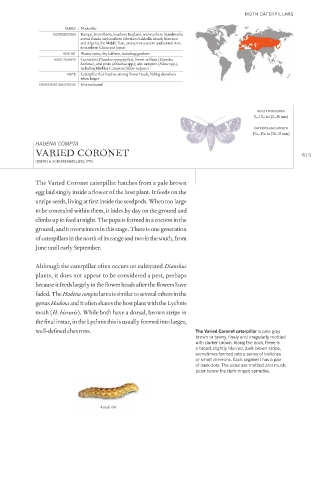
            well-de ned chevrons.                              The Varied Coronet caterpillar is pale gray
                                                               brown or tawny,   nely and irregularly mottled
                                                               with darker brown. Along the back, there is
                                                               a broad, slightly blurred, dark brown stripe,
                                                               sometimes formed into a series of blotches
                                                               or small chevrons. Each segment has a pair
                                                               of dark dots. The sides are mottled and much
                                                               paler below the dark-ringed spiracles.


                                 Actual size

