


Page 619 - The Book of Caterpillars: A Life-Size Guide to Six Hundred Species From Around the World
P. 619
MOTH CATERPILLARS

                      FAMILY  Noctuidae
                  DISTRIBUTION  Northern areas of Africa, the Middle East, and much of southern
                           Asia; migrant farther north, reaching the British Isles, southern
                           Scandinavia, southern Urals, and northern China
                     HABITAT  Dry, generally warm, open habitats, including semidesert and
                           cultivated land, including gardens; also open habitats as a migrant
                  HOST PLANTS  Many, including Asteraceae, such as Pot Marigold (Calendula
                           o   cinalis); Geraniaceae, such as pelargonium (Pelargonium spp.);
                           and Solanaceae such as Deadly Nightshade (Atropa belladonna);
                           also crops such as Chickpea (Cicer arietinum) and Soybean
                           (Glycine max)
                      NOTE  Caterpillar that can be a crop pest in subtropical climates
             CONSERVATION STATUS  Not evaluated


                                                                                   ADULT WINGSPAN
                                                                                  1¼–1⅝ in (32–42 mm)
                                                                                  CATERPILLAR LENGTH
                                                                                  1¼–1½ in (32–38 mm)
            HELIOTHIS PELTIGERA
            BORDERED STRAW                                                                       617

            ([DENIS & SCHIFFERMÜLLER], 1775)


            The Bordered Straw caterpillar hatches from a ribbed, white-
            and-purple egg laid on the food plant. When young, it often lives
            in a slight web near a shoot tip but feeds openly when larger.
            It forms a pupa in a fragile cocoon in the ground. In warm
            climates, this species may breed continuously. Farther north it
            has one to three generations, with migrants arriving from the
            south from May onward. It does not survive temperate winters.


            In subtropical areas, the Bordered Straw caterpillar is often
            reported as a pest on a wide variety of crops, although this

            may sometimes be due to misidenti cation. In more northern,
            temperate areas such as the British Isles, it is not recorded as a
            crop pest and is more likely to be found on garden plants such as
            Calendula and Pelargonium. Some green forms of the extremely
            variable Scarce Bordered Straw (Helicoverpa armigera)
            caterpillar closely resemble the Bordered Straw.


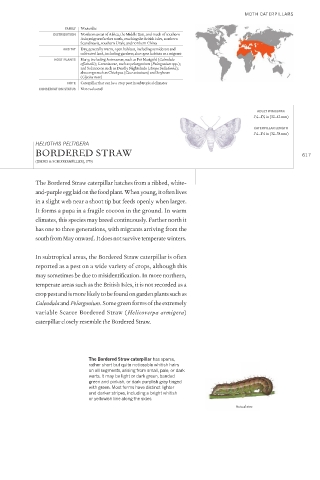
                             The Bordered Straw caterpillar has sparse,
                             rather short but quite noticeable whitish hairs
                             on all segments, arising from small, pale, or dark
                             warts. It may be light or dark green, banded
                             green and pinkish, or dark purplish gray tinged
                             with green. Most forms have distinct lighter
                             and darker stripes, including a bright whitish
                             or yellowish line along the sides.
                                                                            Actual size

