


Page 620 - The Book of Caterpillars: A Life-Size Guide to Six Hundred Species From Around the World
P. 620
MOTH CATERPILLARS

                                                     FAMILY  Noctuidae
                                                 DISTRIBUTION  Across much of United States south of the Great Lakes; Mexico,
                                                          Central America, and the Caribbean
                                                    HABITAT  Meadows and forest edges, as well as disturbed habitat
                                                  HOST PLANTS  Fruit of Giant Ground Cherry (Physalis peruviana),
                                                          Chinese Lantern (Physalis alkekengi), and other Physalis spp.
                                                      NOTE  Caterpillar with a unique diet that protects it from parasitoids
                                             CONSERVATION STATUS  Not evaluated, but common


            ADULT WINGSPAN
           1 ⁄  –1¼ in (27–31 mm)
           CATERPILLAR LENGTH
             1½ in (38 mm)
                                                                           HELIOTHIS SUBFLEXA
                                                 SUBFLEXUS STRAW MOTH
    618
                                                                                    (GUENÉE, 1852)


                                            The Sub exus Straw Moth caterpillar often feeds in seclusion

                                            within lantern-shaped Physalis fruits, a food resource exclusive
                                            to this species, which has developed a unique ability to mature
                                            on a diet lacking linolenic acid. In other caterpillars, linolenic
                                            acid is necessary for producing a chemical, volicitin, in their
                                            saliva. However, the chemical also triggers the production of
                                            volatiles by the plants on which the caterpillars feed, which are
                                            then detected by parasitoids, enabling them to locate the larvae.
                                            The Heliothis sub exa caterpillar avoids such parasitoid attacks

                                            because of its linolenic-acid-free diet.


                                            The moth and its caterpillar are very similar to a close relative,
                                            the Tobacco Budworm (Heliothis virescens). However, H.
                                            virescens is a significant pest on many different crops, from
                                            soybeans to cotton, while H. sub exa is innocuous. The two

                                            exemplify how a seemingly minor adaptation can radically

                                            change the economic signi cance of an insect species. Heliothis
                                            subflexa is barely known, while the diet of H. virescens costs
                                            millions of dollars a year.


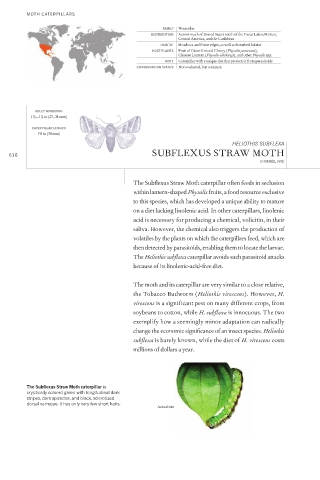
          The Sub exus Straw Moth caterpillar is
          cryptically colored green with longitudinal dark
          stripes, dark spiracles, and black, sclerotized
          dorsal verrucae. It has only very few short hairs.
                                                   Actual size

