


Page 612 - The Book of Caterpillars: A Life-Size Guide to Six Hundred Species From Around the World
P. 612
MOTH CATERPILLARS

                                                     FAMILY  Noctuidae
                                                 DISTRIBUTION  Southern and eastern Europe into southern Russia, Turkey,
                                                          and the Middle East
                                                    HABITAT  Hot, dry, and often rocky slopes, from sea level up to
                                                          6,600 ft (2,000 m) elevation
                                                  HOST PLANTS  Figwort (Scrophularia spp.)
                                                      NOTE  Brightly colored caterpillar that turns into a drab adult
                                             CONSERVATION STATUS  Not evaluated


            ADULT WINGSPAN
             1 ⁄   in (40 mm)
           CATERPILLAR LENGTH
           1⅜–2 in (35–50 mm)


                                                                          CUCULLIA BLATTARIAE
                                                     CUCULLIA BLATTARIAE
    610
                                                                                     (ESPER, 1790)


                                            Cucullia blattariae caterpillars hatch from small, round eggs with
                                            a ridged surface, positioned singly, or in small groups, on the
                                            host plant close to  ower buds. The larvae feed on the buds and

                                            leaves. The mature caterpillars move to the ground to pupate,
                                            spinning a loose cocoon in the leaf litter.

                                            The night- ying adult moths are on the wing from late March

                                            to May—maybe early August at higher elevations—and there
                                            is a single generation. Some authorities refer to the species as
                                            Shargacucullia blattariae (Esper, 1790), Shargacucullia being
                                            a subgenus. Despite having a distinctive caterpillar and a
                                            European distribution, very little is known about this species,
                                            which may in part be due to the drab nature of the adult moth
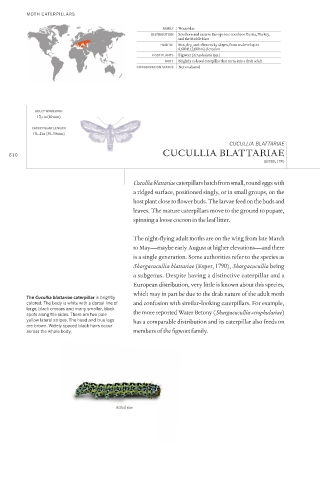
         The Cucullia blattariae caterpillar is brightly
         colored. The body is white with a dorsal line of   and confusion with similar-looking caterpillars. For example,
         large, black crosses and many smaller, black   the more reported Water Betony (Shargacucullia scrophulariae)
         spots along the sides. There are two pale
         yellow lateral stripes. The head and true legs   has a comparable distribution and its caterpillar also feeds on
         are brown. Widely spaced black hairs occur

         across the whole body.             members of the  gwort family.


                                      Actual size

