


Page 616 - The Book of Caterpillars: A Life-Size Guide to Six Hundred Species From Around the World
P. 616
MOTH CATERPILLARS

                                                     FAMILY  Noctuidae
                                                 DISTRIBUTION  Parts of southeast Canada, United States, the Caribbean,
                                                          and through Central America; parts of Brazil, Argentina,
                                                          and Paraguay; Spain, the Canary Islands, and Madeira
                                                    HABITAT  Forests, coastal rain forests, and conifer forests
                                                  HOST PLANTS  Wood sorrel (Oxalis spp.)
                                                      NOTE  Odd-looking, slug-shaped caterpillar in shades of brown
                                             CONSERVATION STATUS  Not evaluated, but rare in much of its range


            ADULT WINGSPAN
            ¾–1 in (20–25 mm)
           CATERPILLAR LENGTH
             1 ⁄   in (30 mm)
                                                                              GALGULA PARTITA
                                                              WEDGLING MOTH
    614
                                                                                     GUENÉE, 1852


                                            The caterpillars of the Wedgling Moth hatch from conical,
                                            ridged eggs laid on the underside of leaves, either singly or in
                                            small clusters. The larvae feed only on wood sorrel, an unusual
                                            food plant as the leaves have high levels of the relatively
                                            unpalatable salt oxalate, which means few animals feed on
                                            them. In fact, this species is the only one to feed on wood
                                            sorrel in North America.


                                            The nocturnal Wedgling Moth is on the wing at di erent times
                                            of year, depending on the location. In the south of their range,
                                            the moths are seen from March to November, while in the north

                                            they  y from May to September. There are several generations
                                            a year. As Galgula partita feeds only on a single plant species,
                                            any loss of that plant’s habitat leads to a decline in moth numbers
                                            due to the lack of alternative host plants, hence the Wedgling’s
                                            increasing rarity in some regions.

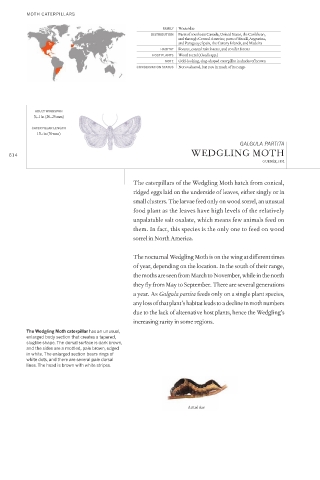
         The Wedgling Moth caterpillar has an unusual,
         enlarged body section that creates a tapered,
         sluglike shape. The dorsal surface is dark brown,
         and the sides are a mottled, pale brown, edged
         in white. The enlarged section bears rings of
         white dots, and there are several pale dorsal
         lines. The head is brown with white stripes.


                                                             Actual size

