


Page 610 - The Book of Caterpillars: A Life-Size Guide to Six Hundred Species From Around the World
P. 610
MOTH CATERPILLARS

                                                     FAMILY  Noctuidae
                                                 DISTRIBUTION  Australia, including Tasmania
                                                    HABITAT  Farmlands, parks, and gardens
                                                  HOST PLANTS  Beans (Fabaceae), canola (Brassica spp.), Chard (Beta vulgaris),

                                                          sun ower (Helianthus spp.), Tomato (Solanum lycopersicum),
                                                          and tobacco (Nicotiana spp.)
                                                      NOTE  Green, semi-looping caterpillar that is found on many crops
                                             CONSERVATION STATUS  Not evaluated


            ADULT WINGSPAN
             1 ⁄   in (30 mm)
           CATERPILLAR LENGTH
             1 ⁄   in (40 mm)
                                                                     CHRYSODEIXIS ARGENTIFERA
                                                             TOBACCO LOOPER
    608
                                                                                    (GUENÉE, 1852)


                                            Tobacco Looper caterpillars hatch from round, white eggs
                                            laid separately on the underside of leaves. Described as a semi-
                                            looper, the larva has two pairs of prolegs rather than four and so
                                            has a partly looping movement, similar to that of the true loopers
                                            of the Geometridae. Each caterpillar spins a white cocoon on
                                            the underside of a leaf, which it camou ages with bits of leaves

                                            and even droppings. The adult moth emerges after a pupation
                                            of around three weeks.


                                            This species is an agricultural pest that attacks many crops.
                                            Young caterpillars feed on one side of the leaf, creating
                                            distinctive “feeding windows,” but as they molt and get larger,
                                            they chew holes in the leaves. Mature caterpillars feed from the
                                            leaf margin, sometimes defoliating whole plants. The caterpillars
                                            also damage crops such as tomatoes by chewing the unripe
                                            fruits, and they bore into the pods of beans and peas to reach the
                                            seeds inside.


                      Actual size

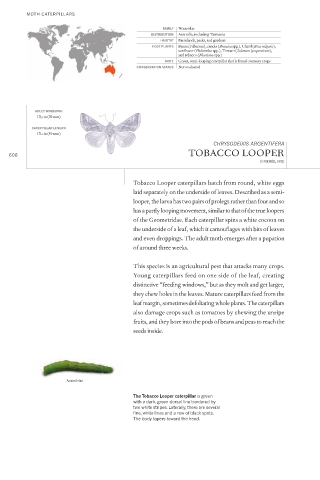
                                            The Tobacco Looper caterpillar is green
                                            with a dark, green dorsal line bordered by
                                            two white stripes. Laterally, there are several
                                              ne, white lines and a row of black spots.
                                            The body tapers toward the head.

