


Page 621 - The Book of Caterpillars: A Life-Size Guide to Six Hundred Species From Around the World
P. 621
MOTH CATERPILLARS

                      FAMILY  Noctuidae
                  DISTRIBUTION  Mostly in southern United States, dispersing north to Canada
                           annually; widely in the Caribbean; sporadically in Central
                           America and South America
                     HABITAT  Disturbed agricultural habitats
                  HOST PLANTS  Many, including tobacco (Nicotiana spp.), beggarweed
                           (Desmodium spp.), Japanese Honeysuckle (Lonicera japonica);
                           lupine (Lupinus spp.), sun ower (Helianthus spp.), and Velvetleaf

                           (Abutilon theophrasti)
                      NOTE  Caterpillar that is a pest of many crops
             CONSERVATION STATUS  Not evaluated, but common


                                                                                   ADULT WINGSPAN
                                                                                  1⅛–1⅜ in (28–35 mm)


                                                                                  CATERPILLAR LENGTH
                                                                                  1–1 ⁄   in (25–36 mm)
            HELIOTHIS VIRESCENS
            TOBACCO BUDWORM                                                                      619

            (FABRICIUS, 1777)


            Tobacco Budworm caterpillars hatch from spherical eggs laid on
            blossoms, fruit, and fresh growth, developing rapidly through
            all instars in as few as 17 days. The larvae are ferocious eaters
            and can even cannibalize each other. Young larvae bore into
            buds and blossoms, but, when the latter are consumed, caterpillars
            will move onto leaves. There are up to seven instars, although

            most commonly  ve or six. Pupation occurs in the soil, but the
            pupa survives the winter generally only in southern United States,
            or in greenhouses and other sheltered locations. Eclosing adults
            may disperse north to New England and even southern Canada
            by late summer.


            The species derives its common name from its tobacco host
            plant, but it is also an important pest of many other species,
            from Alfalfa (Medicago sativa) to Soybean (Glycine max).
            Natural enemies include spiders, birds, and wasp parasitoids in
            the genera Trichogramma, Cardiochiles, Cotesia, and Microplitis.
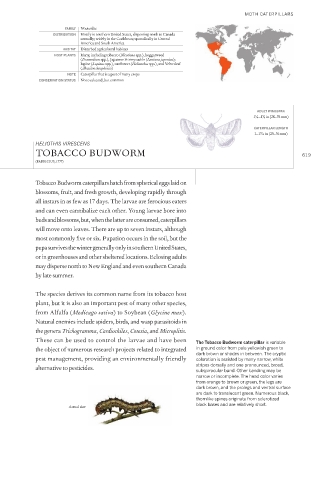
            These can be used to control the larvae and have been   The Tobacco Budworm caterpillar is variable
            the object of numerous research projects related to integrated   in ground color from pale yellowish green to
            pest management, providing an environmentally friendly   dark brown or shades in between. The cryptic
                                                                coloration is assisted by many narrow, white
            alternative to pesticides.                          stripes dorsally and one pronounced, broad,
                                                                subspiracular band. Other banding may be
                                                                narrow or incomplete. The head color varies
                                                                from orange to brown or green, the legs are
                                                                dark brown, and the prolegs and ventral surface
                                                                are dark to translucent green. Numerous black,
                                                                thornlike spines originate from sclerotized
                       Actual size                              black bases and are relatively short.

