


Page 622 - The Book of Caterpillars: A Life-Size Guide to Six Hundred Species From Around the World
P. 622
MOTH CATERPILLARS

                                                     FAMILY  Noctuidae
                                                 DISTRIBUTION  Europe, from Iberia and southern England north to the southern
                                                          and eastern coasts of Scandinavia, and east across southern Siberia
                                                          to Lake Baikal; Canary Islands; North Africa; the Middle East
                                                          through Iran, Turkmenistan, Tajikistan, and eastern Kazakhstan
                                                    HABITAT  Dry, open habitats, particularly on calcareous soils, and including
                                                          coastal shingle, rocky places, scrub, farmlands, grasslands,
                                                          and gardens
                                                  HOST PLANTS  Many, including Caryophyllaceae, such as campion (Silene spp.);
                                                          Fabaceae, such as rest-harrow (Ononis spp.) and Pitch Trefoil
                                                          (Psoralea bituminosa); Asteraceae, such as Smooth Hawk’s-beard
                                                          (Crepis capillaris); Malvaceae, such as cotton (Gossypium spp.);
                                                          and Solanaceae, such as Tomato (Solanum lycopersicum)

                                                      NOTE  Caterpillar feeding on  owers and seeds, sometimes a crop pest
                                             CONSERVATION STATUS  Not evaluated
            ADULT WINGSPAN
           1¼–1 ⁄   in (32–37 mm)
           CATERPILLAR LENGTH
           1 ⁄  –1 ⁄   in (30–35 mm)
                                                                           HELIOTHIS VIRIPLACA
                                                              MARBLED CLOVER
    620
                                                                                   (HUFNAGEL, 1766)


                                            The Marbled Clover caterpillar hatches from a domed, ribbed,

                                            whitish egg laid singly on a  ower of the food plant. It feeds on

                                            the  owers and ripening seedpods and forms a pupa in a slight
                                            cocoon in the ground, which is the overwintering stage. There
                                            are one or two generations annually, the second being sometimes
                                            partial, in July and August and in the fall.

                                            The caterpillars are recorded as pests of crops such as bean and
                                            cotton, but often a closely related species is, in fact, responsible.
                                            Larvae in the genus Heliothis are highly variable, and di erences

                                            between some closely related species are slight, so that the
                                            markings of a single individual can be misleading. The caterpillar
                                            of the Shoulder-striped Clover (H. maritima), which is con ned

                                            to western Europe and highly localized on heathland, coastal
                                            dunes, and saltmarshes, is similar to this species but tends to
                                            show greater contrast in the stripes, as does that of H. adaucta,
                                            a more eastern species.


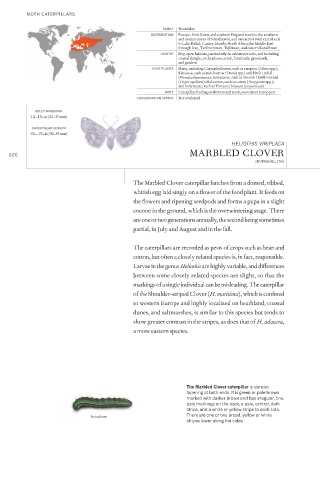
                                                             The Marbled Clover caterpillar is slender,
                                                             tapering at both ends. It is green or pale brown
                                                             marked with darker brown and has irregular,   ne,
                                                             pale markings on the back, a pale, central, dark
                                                             stripe, and a white or yellow stripe to each side.
                              Actual size                    There are one or two broad, yellow or white
                                                             stripes lower along the sides.

