


Page 623 - The Book of Caterpillars: A Life-Size Guide to Six Hundred Species From Around the World
P. 623
MOTH CATERPILLARS

                      FAMILY  Noctuidae
                  DISTRIBUTION  Southern Canada and United States, except southern and
                           central areas

                     HABITAT  Wet meadows, woodlands, riparian areas, and hop  elds
                  HOST PLANTS  Hops (Humulus spp.), nettles (Urtica spp.), and woodnettle
                           (Laportea spp.)
                      NOTE  Looper caterpillar that can be a serious pest of hops
             CONSERVATION STATUS  Not evaluated, but usually common


                                                                                   ADULT WINGSPAN
                                                                                  1–1¼ in (25–32 mm)
                                                                                  CATERPILLAR LENGTH
                                                                                  1–1 ⁄   in (25–30 mm)
            HYPENA HUMULI
            HOP LOOPER                                                                           621

            HARRIS, 1841


            Hop Looper caterpillars hatch from eggs laid singly in spring
            on host plants, such as hops, some three days earlier. Prior
            to ovipositing, the adult females overwinter in caves or old
            buildings. After hatching, the caterpillars develop rapidly, taking
            just 14 days at 78.8°F (26°C) to reach maturity. The larvae move
            with a characteristic looping motion and feed mostly by night.
            Pupation occurs in a slight, silken nest between leaves or on the
            soil surface, and the adult moths emerge after nine to ten days.
            There are two to three generations annually.


            Hop Loopers sometimes occur in large numbers in hopyards
            in the northwestern United States and can defoliate hop vines.
            However, up to 70 percent of Hop Looper caterpillar populations
            may be parasitized by the many species of parasitic wasps and
              ies that attack them. Adult moths can sometimes disappear
            from an area, and it is suspected that they migrate. As adults are
            attracted to a combination of acetic acid and 3-methyl-l-butanol,

            traps containing this mixture are proving an e ective monitoring
            tool for this species.


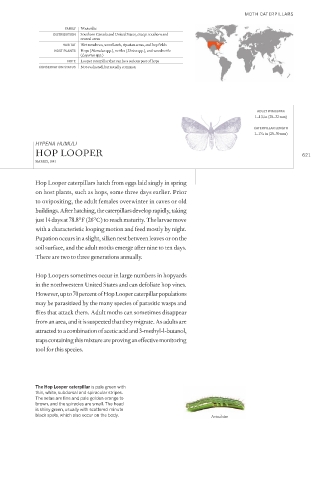
            The Hop Looper caterpillar is pale green with
            thin, white, subdorsal and spiracular stripes.
            The setae are   ne and pale golden orange to
            brown, and the spiracles are small. The head
            is shiny green, usually with scattered minute
            black spots, which also occur on the body.              Actual size

