


Page 624 - The Book of Caterpillars: A Life-Size Guide to Six Hundred Species From Around the World
P. 624
MOTH CATERPILLARS

                                                     FAMILY  Noctuidae
                                                 DISTRIBUTION  North Africa, Europe (except northern Scandinavia), east across
                                                          southern Russia; the Middle East to Afghanistan, northern India,

                                                          and China to the Paci c coast
                                                    HABITAT  Many, but particularly gardens and other cultivated land, rough
                                                          ground with lush herbaceous vegetation, and saltmarsh edges
                                                  HOST PLANTS  Many herbaceous and woody plants, but often Lamb’s-quarters
                                                          (Chenopodium album) and other Chenopodiaceae; also willowherb
                                                          (Epilobium spp.), tobacco (Nicotiana spp.), Tomato (Solanum
                                                          lycopersicum), tamarisk (Tamarix spp.), and elm (Ulmus spp.)
                                                      NOTE  Leaf-feeding caterpillar that also eats tomatoes
                                             CONSERVATION STATUS  Not assessed, but very common


            ADULT WINGSPAN

           1⅜–1¾ in (35–45 mm)

           CATERPILLAR LENGTH
           1 ⁄  –1¾ in (40–45 mm)
                                                                          LACANOBIA OLERACEA
                                                 BRIGHT-LINE BROWN-EYE
    622
                                                                                   (LINNAEUS, 1758)


                                            The Bright-line Brown-eye caterpillar hatches from a yellowish-
                                            green egg and, throughout its development, feeds at night,
                                            usually on the foliage of its food plant, hiding low down by
                                            day. The pupa is formed in a fragile cell in the ground, and this
                                            stage overwinters. There are one or two generations per year
                                            depending on climate. The adults, also known as Tomato Moths,
                                            first appear in May, and caterpillars can be found from June
                                            until late fall.


                                            The caterpillar is most abundant on rich soils where its favored
                                            host plants proliferate. It is well known to gardeners and
                                            horticulturalists as a pest on tomatoes—as well as eating the
                                            leaves it destroys the fruit by burrowing into it. The closely
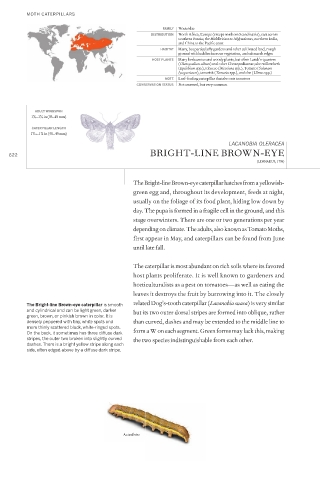
          The Bright-line Brown-eye caterpillar is smooth   related Dog’s-tooth caterpillar (Lacanobia suasa) is very similar
          and cylindrical and can be light green, darker   but its two outer dorsal stripes are formed into oblique, rather
          green, brown, or pinkish brown in color. It is
          densely peppered with tiny, white spots and   than curved, dashes and may be extended to the middle line to
          more thinly scattered black, white-ringed spots.
          On the back, it sometimes has three di  use dark   form a W on each segment. Green forms may lack this, making
          stripes, the outer two broken into slightly curved   the two species indistinguishable from each other.
          dashes. There is a bright yellow stripe along each
          side, often edged above by a di  use dark stripe.


                                        Actual size

