


Page 632 - The Book of Caterpillars: A Life-Size Guide to Six Hundred Species From Around the World
P. 632
MOTH CATERPILLARS

                                                     FAMILY  Noctuidae
                                                 DISTRIBUTION  Across Europe into Russia as far as the Urals; Turkey, Armenia,
                                                          Syria, and parts of North Africa
                                                    HABITAT  Woodlands, scrub, grasslands, parks, and gardens
                                                  HOST PLANTS  Wide range of low-growing plants, particularly White Dead
                                                          Nettle (Lamium album)
                                                      NOTE  Plump, green caterpillar found in almost any European habitat
                                             CONSERVATION STATUS  Not evaluated, but common


            ADULT WINGSPAN
           1¾–2 in (45–50 mm)
           CATERPILLAR LENGTH
             1¾ in (45 mm)
                                                                     PHLOGOPHORA METICULOSA
                                                                   ANGLE SHADES
    630
                                                                                   (LINNAEUS, 1758)


                                            The caterpillars of the Angle Shades moth hatch from pale

                                            brown, slighty  attened, and ridged eggs laid in clusters on the
                                            leaves of a wide variety of host plants. The larvae feed mostly
                                            on leaves, and those of the second generation overwinter and
                                            become active again in spring. The mature caterpillars drop to

                                            the ground, where they spin a  imsy cocoon, either among the
                                            leaf litter or in the soil. The pupa is chestnut brown in color.

                                            The nocturnal Angle Shades moths, which are attracted to
                                            light, are seen from May to October, and there are two or more
                                            generations each year. During the day, they rest on fences, trees,
                                            and shrubs, their disruptive coloration and wing shape giving
                                            the appearance of a withered leaf, which provides excellent


                                            camou age. This is a migrant species that can  y long distances.
                                            It is often seen in large numbers along coastlines.


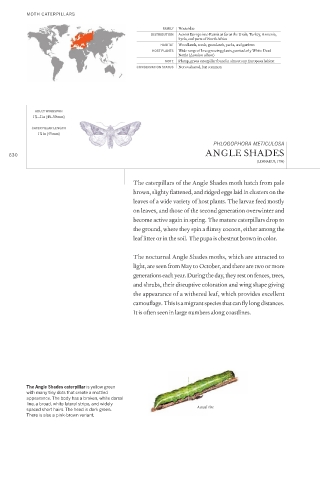
         The Angle Shades caterpillar is yellow green
         with many tiny dots that create a mottled
         appearance. The body has a broken, white dorsal
         line, a broad, white lateral stripe, and widely
         spaced short hairs. The head is dark green.            Actual size
         There is also a pink-brown variant.

