


Page 60 - The Book of Caterpillars: A Life-Size Guide to Six Hundred Species From Around the World
P. 60
BUTTERFLY CATERPILLARS

                                                     FAMILY  Papilionidae
                                                 DISTRIBUTION  India, Southeast Asia (southern China, Chinese Taipei,
                                                          and Indonesia)
                                                    HABITAT  Open forest
                                                  HOST PLANTS  Members of Rutaceae, including Toddalia asiatica,
                                                          Euodia meliifolia, Zanthoxylum rhetsa, and Citrus spp.
                                                      NOTE  Caterpillar with menacing eyespots, exhibiting classic mimicry
                                                          of swallowtail larvae
                                             CONSERVATION STATUS  Not evaluated, but common within its range


            ADULT WINGSPAN
           4–4⅞ in (100–125 mm)
           CATERPILLAR LENGTH
             2 in (50 mm)
                                                                             PAPILIO NEPHELUS
                                                                  YELLOW HELEN
    58
                                                                                   BOISDUVAL, 1836


                                            Early instar caterpillars are bird-dropping mimics with earthy
                                            colors and a glossy, even slimy finish. The fifth and final instar


                                            caterpillar is a complete departure in appearance—eyespots
                                            and a widened thorax successfully emulate a menacing “snake’s
                                            head” appearance, while the caterpillar’s real head is tucked
                                            safely beneath. All stages possess an eversible, malodorous
                                            osmeterium to startle and repel potential threats. The chrysalis
                                            is angular and green and can be mistaken easily for foliage.


                                            The Yellow Helen (or Black and White Helen, according to

                                            subspecies) belongs to a clade of related swallowtail butterflies,
                                            the helenus group, or Helens, which are typically large,
                                            predominantly black butterflies with long tails and a large, white

                                            area on the hindwings. Like other Papilio species, P. nephelus has

                                            evolved specific kinds of protective adaptation, such as crypsis
                                            (larval and pupal coloration), chemical (osmeterium secretions
                                            that change with age and size), and mimicry (bird-dropping and
                                            eyespot markings and posture). These progressively protect the
                                            species against different types and sizes of predator, from ants to

                                            birds, throughout its life cycle.


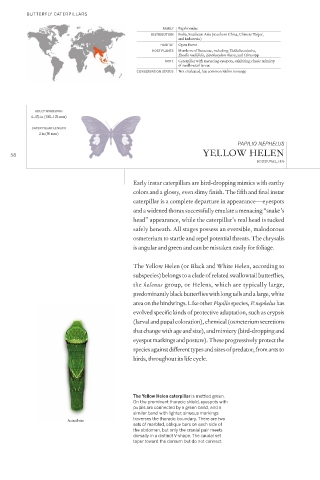
                                            The Yellow Helen caterpillar is mottled green.
                                            On the prominent thoracic shield, eyespots with
                                            pupils are connected by a green band, and a
                                            similar band with lighter, sinuous markings
                       Actual size          traverses the thoracic boundary. There are two
                                            sets of marbled, oblique bars on each side of
                                            the abdomen, but only the cranial pair meets
                                            dorsally in a distinct V-shape. The caudal set
                                            taper toward the dorsum but do not connect.

