


Page 61 - The Book of Caterpillars: A Life-Size Guide to Six Hundred Species From Around the World
P. 61
BUTTERFLY CATERPILLARS

                      FAMILY  Papilionidae
                  DISTRIBUTION  Eastern and central North America, south to Peru
                     HABITAT  Open woods, grassland, and desert
                  HOST PLANTS  Several, including carrot (Daucus spp.), parsley (Petroselinum
                           spp.), Dill (Anethum graveolens), and Parsnip (Pastinaca sativa);
                           Turpentine Broom (Thamnosma montana) in Arizona
                      NOTE  Caterpillar with a snake-tongue secret weapon for
                           repelling predators
             CONSERVATION STATUS  Not evaluated, but common


                                                                                   ADULT WINGSPAN
                                                                                  3⅛–4¼ in (80–110 mm)
                                                                                  CATERPILLAR LENGTH
                                                                                    2 in (50 mm)
            PAPILIO POLYXENES
            BLACK SWALLOWTAIL                                                                     59

            FABRICIUS, 1775


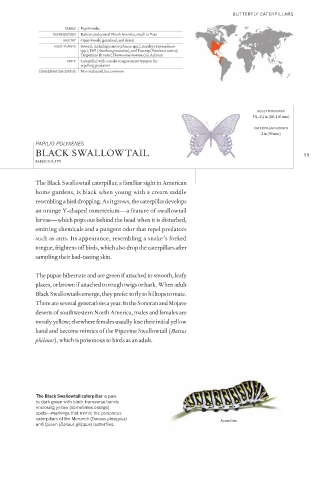
            The Black Swallowtail caterpillar, a familiar sight in American
            home gardens, is black when young with a cream saddle
            resembling a bird dropping. As it grows, the caterpillar develops
            an orange Y-shaped osmeterium—a feature of swallowtail
            larvae—which pops out behind the head when it is disturbed,
            emitting chemicals and a pungent odor that repel predators
            such as ants. Its appearance, resembling a snake’s forked

            tongue, frightens off birds, which also drop the caterpillars after
            sampling their bad-tasting skin.


            The pupae hibernate and are green if attached to smooth, leafy
            places, or brown if attached to rough twigs or bark. When adult
            Black Swallowtails emerge, they prefer to fly to hilltops to mate.

            There are several generations a year. In the Sonoran and Mojave
            deserts of southwestern North America, males and females are
            mostly yellow; elsewhere females usually lose their initial yellow
            band and become mimics of the Pipevine Swallowtail (Battus
            philenor), which is poisonous to birds as an adult.


            The Black Swallowtail caterpillar is pale
            to dark green with black transverse bands
            enclosing yellow (sometimes orange)
            spots—markings that mimic the poisonous
            caterpillars of the Monarch (Danaus plexippus)             Actual size
            and Queen (Danaus gilippus) butter  ies.

