


Page 82 - The Book of Caterpillars: A Life-Size Guide to Six Hundred Species From Around the World
P. 82
BUTTERFLY CATERPILLARS
FAMILY Hesperiidae
DISTRIBUTION The Andes of Colombia, Ecuador, and Peru, probably also
northern Bolivia
HABITAT Montane landslides, treefall gaps, and other areas dominated
by Chusquea bamboo
HOST PLANTS Bamboo (Chusquea spp.)
NOTE Nondescript caterpillar that is frequently parasitized by
tachinid flies
CONSERVATION STATUS Not evaluated, but not considered threatened
ADULT WINGSPAN
2⅛–2⁄ in (55–65 mm)
CATERPILLAR LENGTH
1⅛–1⁄ in (28–34 mm)
DION CARMENTA
DION CARMENTA
80
(HEWITSON, 1870)
The Dion carmenta caterpillar hatches from a round, whitish egg
laid singly on the underside of a leaf by the female during only a
three- or four-second pause. At first, the larvae have black heads
with white, unadorned bodies, slowly developing a reddish tinge
to thoracic segments as they grow but otherwise changing little
during ontogeny. Larvae of all instars construct and dwell in
shelters built on the food plant and forcibly eject frass with the
aid of an anal comb.
Pupation occurs on the food plant in a shelter formed by silking
multiple leaves into a tube. Development, from oviposition to
eclosion, lasts 128 to 147 days. Adults, which are encountered
infrequently, feed on a variety of flowers, generally at forest
edges and clearings. Females oviposit while flying rapidly over
large patches of their host, touching down briefly on the upper
side of leaves but otherwise maintaining rapid and erratic flight.
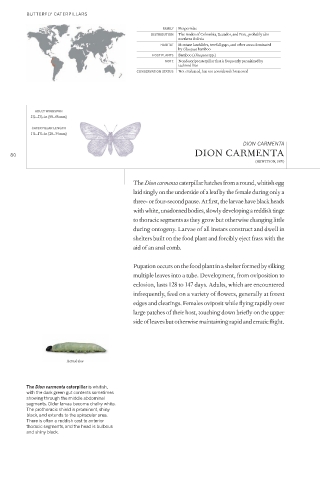
Actual size
The Dion carmenta caterpillar is whitish,
with the dark green gut contents sometimes
showing through the middle abdominal
segments. Older larvae become chalky white.
The prothoracic shield is prominent, shiny
black, and extends to the spiracular area.
There is often a reddish cast to anterior
thoracic segments, and the head is bulbous
and shiny black.

