


Page 81 - The Book of Caterpillars: A Life-Size Guide to Six Hundred Species From Around the World
P. 81
BUTTERFLY CATERPILLARS
FAMILY Hesperiidae
DIS TRIBUTION Indonesia, Papua New Guinea, and scattered areas of Australia
DISTRIBUTION
DISTRIBUTION
HABIT A T Rain forests and urban gardens
HABITAT
HABITAT
HOST PLANTS
HOST PLANTS S Many species of palm (Arecaceae)
T PLANT
HOS
NOTE
NOTE
NO TE Caterpillars that can be minor pests of ornamental palms
CONSERV A TION S T A TUS Not evaluated, but common
CONSERVATION STATUS
CONSERVATION STATUS
ADULT WINGSPAN
1⁄–1⅝ in (37–41 mm)
CATERPILLAR LENGTH
1⁄–2 in (40–50 mm)
CEPHRENES AUGIADES
ORANGE PALM-DART 79
(C. FELDER, 1860)
The Orange Palm-dart caterpillar forms two types of shelter—
tubular (by rolling the leaf pinnae) or flat, created between
overlapping leaves—using silk to bind them. The caterpillar
emerges at night to feed at the edges of the pinnae. As the
caterpillar grows, it constructs new, larger shelters. Considerable
damage to fronds can occur when larval numbers are high.
Several generations can be completed each year, with the
development of the caterpillar slowing in the cooler months,
and an extra sixth instar may be completed.
Pupation generally occurs in the final shelter, but sometimes
the caterpillar will leave the palm and pupate in leaf litter at the
base of the tree. At pupation, the pale brown, cylindrical pupa
becomes covered with a white, waxy powder. In recent years
the range of the Orange Palm-dart has expanded as a result of
widespread planting of ornamental palms outside the natural
habitat of the butterfly.
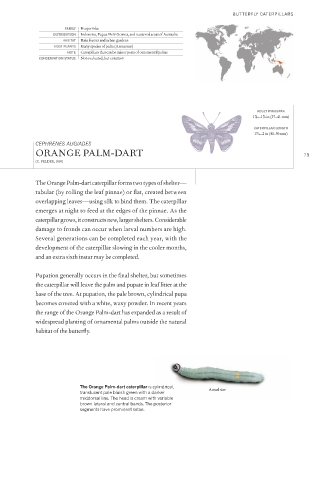
The Orange Palm-dart caterpillar is cylindrical, Actual size
translucent pale bluish green with a darker
middorsal line. The head is cream with variable
brown lateral and central bands. The posterior
segments have prominent setae.

