


Page 85 - The Book of Caterpillars: A Life-Size Guide to Six Hundred Species From Around the World
P. 85
BUTTERFLY CATERPILLARS
FAMILY Hesperiidae
DISTRIBUTION Southern Canada, most of the United States
HABITAT Open, flowery places at lower to middle elevations,
including parks, gardens, and watercourses
HOST PLANTS Deervetch (Lotus spp.), locust (Robinia spp.), and Wild Licorice
(Glycyrrhiza lepidota)
NOTE Head-twitching, frass-ejecting skipper caterpillar
CONSERVATION STATUS Not evaluated, but common
ADULT WINGSPAN
2–2⅛ in (50–55 mm)
CATERPILLAR LENGTH
1³∕₈–1⁄ in (35–40 mm)
EPARGYREUS CLARUS
SILVER-SPOTTED SKIPPER 83
(CRAMER, 1775)
Silver-spotted Skipper caterpillars hatch from eggs laid singly
on the terminal leaves of host plants, typically only one egg
per plant. Initially, the first instar larva cuts a small terminal
leaf twice, both cuts on the same side and perpendicular to the
midrib. It then folds the flap over the upper surface to make a
shelter by silking it in place. In later instars the larger caterpillar Actual size
silks together two or three leaves to create its home. Caterpillars
spend most of their time in shelters, only leaving them to feed.
The pupa is suspended horizontally from the ceiling of a shelter
with three silk threads. There are five instars, and the pupa
overwinters. Protection is based on concealment, nocturnal
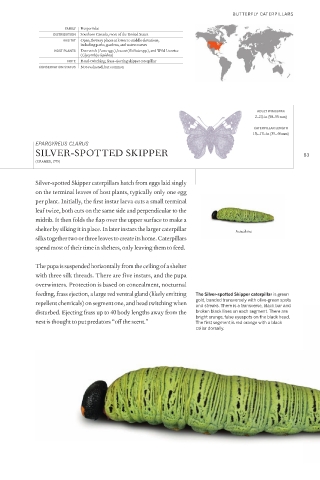
feeding, frass ejection, a large red ventral gland (likely emitting The Silver-spotted Skipper caterpillar is green
repellent chemicals) on segment one, and head twitching when gold, banded transversely with olive-green spots
and streaks. There is a transverse, black bar and
disturbed. Ejecting frass up to 40 body lengths away from the broken black lines on each segment. There are
nest is thought to put predators “off the scent.” bright orange, false eyespots on the black head.
The rst segment is red orange with a black
collar dorsally.

