


Page 84 - The Book of Caterpillars: A Life-Size Guide to Six Hundred Species From Around the World
P. 84
BUTTERFLY CATERPILLARS
FAMILY Hesperiidae
DISTRIBUTION El Salvador, Nicaragua, south to northern Peru and
Amazonian Brazil
HABITAT Roadsides, clearings, and forest gaps in humid and semi-humid
Andean foothill forests
HOST PLANTS Various species of grasses (Poaceae)
NOTE Caterpillar that builds well-concealed, rudimentary,
grass-blade shelters
CONSERVATION STATUS Not evaluated, but not considered threatened
ADULT WINGSPAN
1⅜–1¾ in (35–45 mm)
CATERPILLAR LENGTH
1⅛–1⁄ in (28–36 mm)
ENOSIS UZA
BLUE-SPOTTED SKIPPER
82
(HEWITSON, 1877)
Blue-spotted Skipper caterpillars hatch from round, whitish
eggs laid singly, usually on the underside of leaves. The larvae
build simple shelters on their host leaves, creating ever larger
structures as they develop and grow at each instar. Young larvae
roll the leaf edge into a tube, and larger instars may roll the
entire leaf into a tube, making it barely distinguishable from
Actual size
surrounding grass blades. Frass is expelled from the shelter
with the aid of an anal comb. Pupation likely takes place in the
final larval shelter.
In the right habitat, the caterpillars can be abundant, but are so
well hidden in their camouflaged shelters that a practiced eye
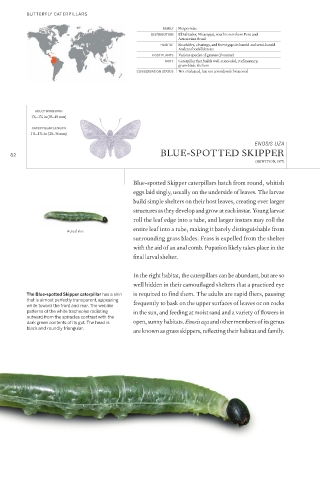
The Blue-spotted Skipper caterpillar has a skin is required to find them. The adults are rapid fliers, pausing
that is almost perfectly transparent, appearing frequently to bask on the upper surfaces of leaves or on rocks
white toward the front and rear. The weblike
patterns of the white tracheoles radiating in the sun, and feeding at moist sand and a variety of flowers in
outward from the spiracles contrast with the
dark green contents of its gut. The head is open, sunny habitats. Enosis uza and other members of its genus
black and roundly triangular. are known as grass skippers, reflecting their habitat and family.

