


Page 83 - The Book of Caterpillars: A Life-Size Guide to Six Hundred Species From Around the World
P. 83
BUTTERFLY CATERPILLARS

                      FAMILY  Hesperiidae
                  DISTRIBUTION  Southern Mexico and the Greater Antilles, south to Paraguay
                           and northern Argentina
                     HABITAT  Humid and semi-humid clearings, forest borders, and
                           river margins
                  HOST PLANTS  Citrus spp. and Zanthoxylum spp.
                      NOTE  Widespread and common caterpillar on cultivated Citrus
                           in gardens
             CONSERVATION STATUS  Not evaluated


                                                                                   ADULT WINGSPAN
                                                                                  1½–1⅞ in (38–48 mm)
                                                                                  CATERPILLAR LENGTH
                                                                                  1½–1¾ in (38–44 mm)
            EANTIS THRASO
            SOUTHERN SICKLEWING                                                                   81

            (HÜBNER, [1807])


            Southern Sicklewing caterpillars hatch from eggs laid singly,
            usually on the underside of very young leaves, but sometimes
            wedged between two leaf buds; the females pause only
            momentarily, perching above and curling their abdomen down
            and under to find a suitable site. Like most species feeding on

            plants of family Rutaceae, the larvae consume mainly the young,
            new shoots of their host plant, presumably to avoid noxious
            chemicals that develop as the leaves mature. When disturbed,
            the caterpillars often rear back, occasionally vomiting and trying
            to bite the intruder.


            All instars build and rest inside leaf shelters constructed out of
            host leaves, expelling their frass a distance many times their own
            body length with the help of an anal comb. Young larvae excise
            a small portion of leaf from the margin to create a shelter “lid,”
            folded to the dorsal surface of the leaf. Later instars usually silk
            together two overlapping leaf blades. Pupae are attached by
            heavy silking to the ventral surface of the shelter. Adults are

            fast fliers and frequently take nectar from the flowers of their

            larval host plants.                                             Actual size


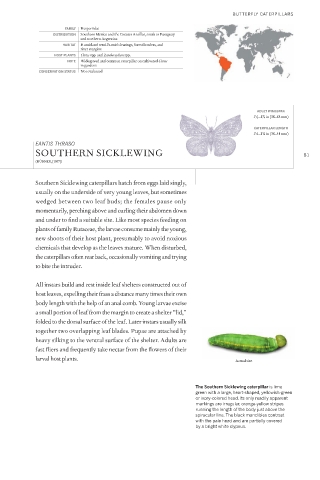
                                                               The Southern Sicklewing caterpillar is lime
                                                               green with a large, heart-shaped, yellowish-green
                                                               or ivory-colored head. Its only readily apparent
                                                               markings are irregular, orange-yellow stripes
                                                               running the length of the body just above the
                                                               spiracular line. The black mandibles contrast
                                                               with the pale head and are partially covered
                                                               by a bright white clypeus.

