


Page 21 - (DK) Eyewitness - Mars
P. 21
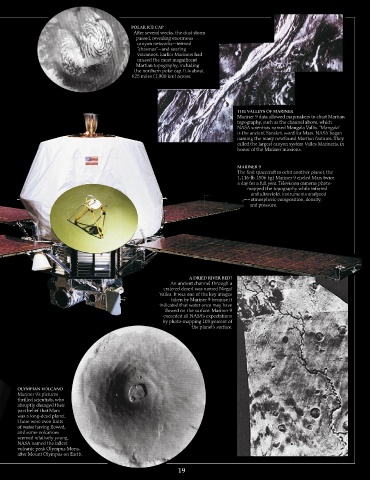
Mariner 9: first to orbit Mars             POLAR ICE CAP
                                             After several weeks, the dust storm
                                              passed, revealing enormous
                                              canyon networks—termed
                                              “chasmas”—and soaring
                                              volcanoes. Earlier Mariners had
                                              missed the most magnificent
                                              Martian topography, including
                                             the northern polar cap. It is about
                                             625 miles (1,000 km) across.


                                                                                THE VALLEYS OF MARINER
                                                                                Mariner 9 data allowed mapmakers to chart Martian
                                                                                topography, such as the channel above, which
                                                                                NASA scientists named Mangala Vallis. “Mangala”
                                                                                is the ancient Sanskrit word for Mars. NASA began
                                                                                naming the many newfound Martian features. They
                                                                                called the largest canyon system Valles Marineris, in
                                                                                honor of the Mariner missions.


                                                                                MARINER
                                                                                The first spacecraft to orbit another planet, the
                                                                                1,116-lb. (506 kg) Mariner 9 circled Mars twice
                                                                                a day for a full year. Television cameras photo-
                                                                                   mapped the topography while infrared
                                                                                    and ultraviolet instruments analyzed
                                                                                    atmospheric composition, density,
                                                                                    and pressure.


                                                                A DRIED RIVER BED?
                                                         An ancient channel through a
                                                       cratered desert was named Nirgal
                                                      Valles. It was one of the key images
                                                          taken by Mariner 9 because it
                                                      indicated that water once may have
                                                        flowed on the surface. Mariner 9
                                                       exceeded all NASA’s expectations
                                                       by photo-mapping 100 percent of
                                                                the planet’s surface.


       OLYMPIAN VOLCANO
       Mariner 9’s pictures
       thrilled scientists, who
       abruptly changed their
       past belief that Mars
       was a long-dead planet.
       There were even hints
       of water having flowed,
       and some volcanoes
       seemed relatively young.
       NASA named the tallest
       volcanic peak Olympus Mons,
       after Mount Olympus on Earth.

                                                            1

