


Page 20 - (DK) Eyewitness - Mars
P. 20
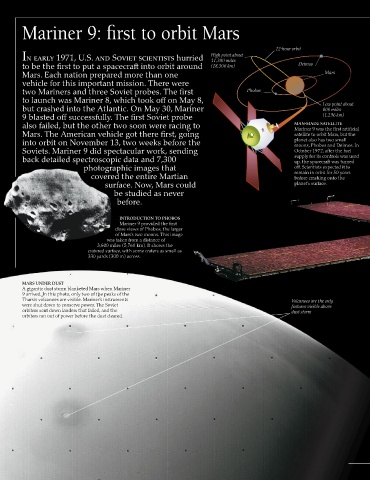
Mariner 9: first to orbit Mars


                                                                                            12-hour orbit
        In early 1971, U.S. and Soviet scientists hurried              High point about
                                                                       11,300 miles
        to be the first to put a spacecraft into orbit around          (18,306 km)                  Deimos
        Mars. Each nation prepared more than one                                                            Mars
        vehicle for this important mission. There were
        two Mariners and three Soviet probes. The first                            Phobos
        to launch was Mariner 8, which took off on May 8,
        but crashed into the Atlantic. On May 30, Mariner                                                   Low point about
                                                                                                            800 miles
        9 blasted off successfully. The first Soviet probe                                                  (1,296 km)
        also failed, but the other two soon were racing to                                        MAN-MADE SATELLITE
                                                                                                  Mariner 9 was the first artificial
        Mars. The American vehicle got there first, going                                         satellite to orbit Mars, but the
        into orbit on November 13, two weeks before the                                           planet also has two small
                                                                                                  moons, Phobos and Deimos. In
        Soviets. Mariner 9 did spectacular work, sending                                          October 1972, after the fuel
        back detailed spectroscopic data and 7,300                                                supply for its controls was used
                                                                                                  up, the spacecraft was turned
                             photographic images that                                             off. Scientists expected it to
                               covered the entire Martian                                         remain in orbit for 50 years
                                                                                                  before crashing onto the
                                    surface. Now, Mars could                                      planet’s surface.
                                       be studied as never
                                        before.


                                         INTRODUCTION TO PHOBOS
                                         Mariner 9 provided the first
                                       close views of Phobos, the larger
                                       of Mars’s two moons. This image
                                    was taken from a distance of
                                 3,600 miles (5,760 km). It shows the
                              cratered surface, with some craters as small as
                              330 yards (300 m) across.


        MARS UNDER DUST
        A gigantic dust storm blanketed Mars when Mariner
        9 arrived. In this photo, only two of the peaks of the
        Tharsis volcanoes are visible. Mariner’s instruments                                     Volcanoes are the only
        were shut down to conserve power. The Soviet                                             features visible above
        orbiters sent down landers that failed, and the                                          dust storm
        orbiters ran out of power before the dust cleared.

