


Page 22 - (DK) Eyewitness - Mars
P. 22
The first successful landings


                                                          In mid-1975, the Kennedy Space Center in
                                                          Florida sent Vikings 1 and 2 on their way to Mars.
                                                          Each carried a lander to be placed on the surface.
                                                          Launched in August, Viking 1 went into orbit
                                                          around Mars in June 1976, and in July its lander
                                                          module descended by parachute onto a boulder-
                                                          covered northern plain. There, it began searching
                                                         the soil for signs of life—the mission’s main task. In
                                                       September 1976, Viking 2 put down its lander on a
                                                     plain halfway around the globe and farther north. The
                                                    landers took dramatic photographs of the Martian
                                                    surface and also tested the gases in the atmosphere.
                                                    Their journeys, successful landings, and the wealth of
         EARTH TO MARS
         This dish antenna at a tracking station in Goldstone,   data they gathered made Vikings 1 and 2 immense
         California, communicated with the two Viking
         spacecraft. NASA’s Deep Space Network managed   triumphs for NASA. Yet, their most important mission
         this station and two others, in Spain and Australia.   had disappointing results: they found no Martian life.
         Each station had three antennas, with the largest
         230 feet (70 m) in diameter.
                                           VIKING PARACHUTES TO MARS
                                           On July 20, 1976, computers on board
                                           Viking 1 separated orbiter and lander, and
                                           the lander’s flight path bent gradually down
                                           to Mars. As the descent through the final
                                           mile (1.6 km) started, a parachute deployed—
                                           as is shown in this illustration. The lander
                                           was still in its protective aeroshell.


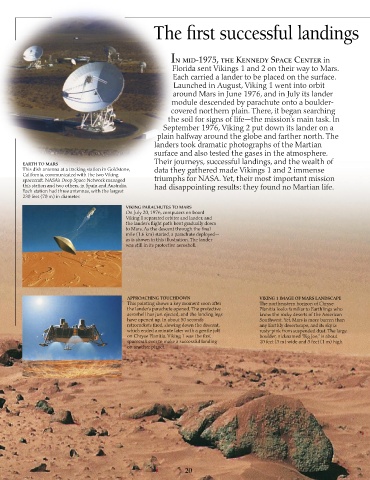
                                           APPROACHING TOUCHDOWN                       VIKING 1 IMAGE OF MARS LANDSCAPE
                                           This painting shows a key moment soon after   The northeastern horizon of Chryse
                                           the lander’s parachute opened. The protective   Planitia looks familiar to Earthlings who
                                           aeroshell has just ejected, and the landing legs   know the rocky deserts of the American
                                           have opened up. In about 50 seconds         Southwest. Yet, Mars is more barren than
                                           retrorockets fired, slowing down the descent,   any Earthly desertscape, and its sky is
                                           which ended a minute later with a gentle jolt   rusty-pink from suspended dust. The large
                                           on Chryse Planitia. Viking 1 was the first   boulder, nicknamed “Big Joe,” is about
                                           spacecraft ever to make a successful landing   10 feet (3 m) wide and 3 feet (1 m) high.
                                           on another planet.


                                                              20

