


Page 23 - (DK) Eyewitness - Mars
P. 23
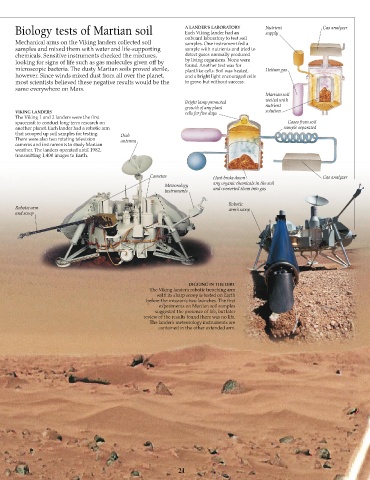
Biology tests of Martian soil                           A LANDER’S LABORATORY      Nutrient           Gas analyzer
                                                              Each Viking lander had an
                                                                                         supply
                                                              onboard laboratory to test soil
      Mechanical arms on the Viking landers collected soil    samples. One instrument fed a
      samples and mixed them with water and life-supporting   sample with nutrients and tried to
      chemicals. Sensitive instruments checked the mixtures,   detect gases normally produced
      looking for signs of life such as gas molecules given off by   by living organisms. None were
      microscopic bacteria. The dusty Martian soils proved sterile,   found. Another test was for   Helium gas
                                                              plantlike cells. Soil was heated,
      however. Since winds mixed dust from all over the planet,   and a bright light encouraged cells
      most scientists believed these negative results would be the   to grow, but without success.
      same everywhere on Mars.
                                                                                         Martian soil
                                                              Bright lamp promoted       wetted with
                                                              growth of any plant        nutrient
      VIKING LANDERS                                          cells for five days        solution
      The Viking 1 and 2 landers were the first
      spacecraft to conduct long-term research on                                               Gases from soil
      another planet. Each lander had a robotic arm                                            sample separated
      that scooped up soil samples for testing.   Dish
      There were also two rotating television   antenna
      cameras and instruments to study Martian
      weather. The landers operated until 1982,
      transmitting 1,400 images to Earth.


                                                   Cameras              Heat broke down                     Gas analyzer
                                                                        any organic chemicals in the soil
                                                        Meteorology
                                                        instruments     and converted them into gas

                                                                             Robotic
      Robotic arm                                                            arm’s scoop
      and scoop


                                                               DIGGING IN THE DIRT
                                                   The Viking lander’s robotic trenching arm
                                                     with its sharp scoop is tested on Earth
                                                 before the mission’s two launches. The first
                                                      experiments on Martian soil samples
                                                    suggested the presence of life, but later
                                                 review of the results found there was no life.
                                                   The lander’s meteorology instruments are
                                                     contained in the other extended arm.


                                                            21

