


Page 34 - (DK) Eyewitness - Mars
P. 34
Martian highs and lows


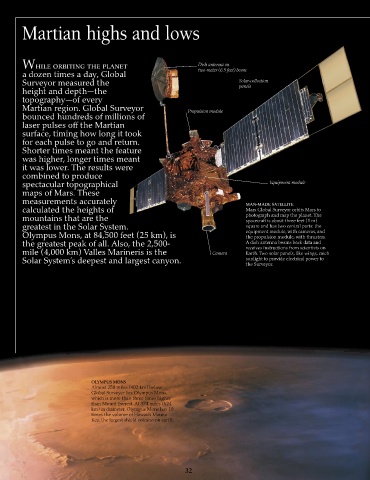
        While orbiting the planet                                  Dish antenna on
        a dozen times a day, Global                                two-meter (6.5 feet) boom
        Surveyor measured the                                                   Solar-collection
        height and depth—the                                                    panels
        topography—of every
        Martian region. Global Surveyor                        Propulsion module
        bounced hundreds of millions of
        laser pulses off the Martian
        surface, timing how long it took
        for each pulse to go and return.
        Shorter times meant the feature
        was higher, longer times meant
        it was lower. The results were
        combined to produce
        spectacular topographical                                                         Equipment module
        maps of Mars. These
        measurements accurately                                                   MAN-MADE SATELLITE
        calculated the heights of                                                 Mars Global Surveyor orbits Mars to
        mountains that are the                                                    photograph and map the planet. The
                                                                                  spacecraft is about three feet (1 m)
        greatest in the Solar System.                                             square and has two central parts: the
        Olympus Mons, at 84,500 feet (25 km), is                                  equipment module, with cameras, and
                                                                                  the propulsion module, with thrusters.
        the greatest peak of all. Also, the 2,500-                                A dish antenna beams back data and
        mile (4,000 km) Valles Marineris is the                        Camera     receives instructions from scientists on
                                                                                  Earth. Two solar panels, like wings, catch
        Solar System’s deepest and largest canyon.                                sunlight to provide electrical power to
                                                                                  the Surveyor.


                               OLYMPUS MONS
                               Almost 250 miles (402 km) below
                               Global Surveyer lies Olympus Mons,
                               which is more than three times higher
                               than Mount Everest. At 374 miles (624
                               km) in diameter, Olympus Mons has 10
                               times the volume of Hawaii’s Mauna
                               Kea, the largest shield volcano on earth.


                                                              32

