


Page 114 - (DK) Ocean - The Definitive Visual Guide
P. 114
112     COASTS AND THE SEASHORE


                  PACIFIC OCEAN SOUTHWEST    and fronts a series of dunes. Waves
                                             generally break too close to the
               Ninety Mile Beach             beach for good surfing, and strong
                                             rip currents make the conditions
                              TYPE  Dissipative coastal   hazardous for swimmers. In its
                              plain beach    northeastern part, several large lakes
                              COMPOSITION  Yellow   and shallow lagoons, known as the
                              sand           Gippsland Lakes, lie behind the dunes.
                              LENGTH  90 miles   Beneath the sea, vast plains of sand
                              (145 km)       stretch in every direction and are
               LOCATION  Southeast of Melbourne, Victoria,   home to a large variety of small
               southeastern Australia        invertebrate life, including crustaceans,
                                             worms, and burrowing mollusks.
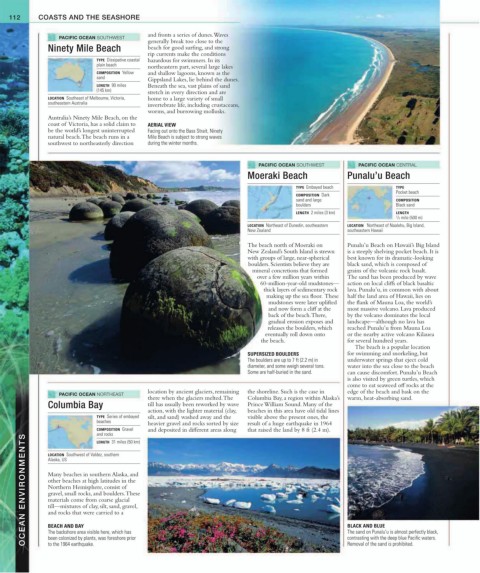
               Australia’s Ninety Mile Beach, on the
               coast of  Victoria, has a solid claim to   AERIAL VIEW
               be the world’s longest uninterrupted   Facing out onto the Bass Strait, Ninety
               natural beach. The beach runs in a   Mile Beach is subject to strong waves
               southwest to northeasterly direction   during the winter months.


                                                                              PACIFIC OCEAN SOUTHWEST       PACIFIC OCEAN CENTRAL
                                                                           Moeraki Beach                Punalu’u Beach
                                                                                         TYPE  Embayed beach           TYPE
                                                                                                                       Pocket beach
                                                                                         COMPOSITION  Dark
                                                                                         sand and large                COMPOSITION
                                                                                         boulders                      Black sand
                                                                                         LENGTH  2 miles (3 km)        LENGTH
                                                                                                                       1 / 3 mile (500 m)
                                                                           LOCATION  Northeast of Dunedin, southeastern    LOCATION   Northeast of Naalehu, Big Island,
                                                                           New Zealand                  southeastern Hawaii
                                                                           The beach north of Moeraki on    Punalu’u Beach on Hawaii’s Big Island
                                                                           New Zealand’s South Island is strewn  is a steeply shelving pocket beach. It is
                                                                           with groups of large, near-spherical  best known for its dramatic-looking
                                                                           boulders. Scientists believe they are  black sand, which is composed of
                                                                            mineral concretions that formed  grains of the volcanic rock basalt.
                                                                              over a few million years within   The sand has been produced by wave
                                                                               60-million-year-old mudstones—  action on local cliffs of black basaltic
                                                                                thick layers of sedimentary rock   lava. Punalu’u, in common with about
                                                                                making up the sea floor.  These   half the land area of Hawaii, lies on
                                                                                 mudstones were later uplifted   the flank of Mauna Loa, the world’s
                                                                                 and now form a cliff at the   most massive volcano. Lava produced
                                                                                 back of the beach. There,   by the volcano dominates the local
                                                                                 gradual erosion exposes and   landscape—although no lava has
                                                                                 releases the boulders, which   reached Punalu’u from Mauna Loa
                                                                                eventually roll down onto    or the nearby active volcano Kilauea
                                                                               the beach.               for several hundred years.
                                                                                                           The beach is a popular location
                                                                           SUPERSIZED BOULDERS          for swimming and snorkeling, but
                                                                           The boulders are up to 7 ft (2.2 m) in    underwater springs that eject cold
                                                                           diameter, and some weigh several tons.    water into the sea close to the beach
                                                                           Some are half-buried in the sand.  can cause discomfort. Punalu’u Beach
                                                                                                        is also visited by green turtles, which
                                                                                                        come to eat seaweed off rocks at the
                  PACIFIC OCEAN NORTHEAST    location by ancient glaciers, remaining   the shoreline. Such is the case in   edge of the beach and bask on the
                                             there when the glaciers melted. The   Columbia Bay, a region within Alaska’s   warm, heat-absorbing sand.
               Columbia Bay                  till has usually been reworked by wave   Prince William Sound. Many of the
                                             action, with the lighter material (clay,   beaches in this area have old tidal lines
                              TYPE  Series of embayed   silt, and sand) washed away and the   visible above the present ones, the
                              beaches        heavier gravel and rocks sorted by size   result of a huge earthquake in 1964
                              COMPOSITION  Gravel   and deposited in different areas along   that raised the land by 8 ft (2.4 m).
                              and rocks
        OCEAN ENVIRONMENTS  Many beaches in southern Alaska, and                                        BLACK AND BLUE
                              LENGTH  31 miles (50 km)
               LOCATION  Southwest of Valdez, southern
               Alaska, US


               other beaches at high latitudes in the
               Northern Hemisphere, consist of
               gravel, small rocks, and boulders. These
               materials come from coarse glacial
               till—mixtures of clay, silt, sand, gravel,
               and rocks that were carried to a

               BEACH AND BAY
                                                                                                        The sand on Punalu’u is almost perfectly black,
               The backshore area visible here, which has
                                                                                                        contrasting with the deep blue Pacific waters.
               been colonized by plants, was foreshore prior
                                                                                                        Removal of the sand is prohibited.
               to the 1964 earthquake.

