


Page 130 - (DK) Ocean - The Definitive Visual Guide
P. 130
128     COASTS AND THE SEASHORE


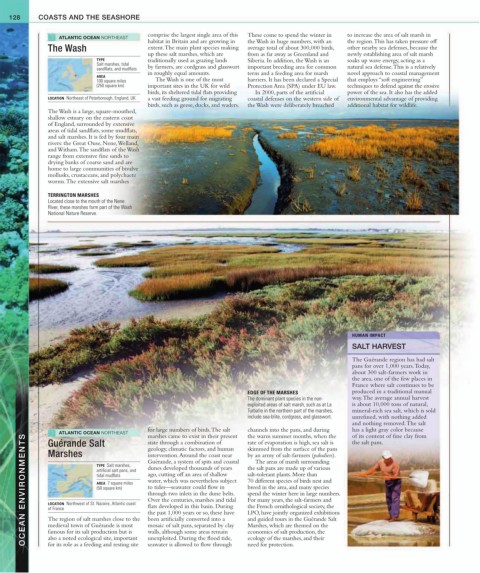
                  ATLANTIC OCEAN NORTHEAST   comprise the largest single area of this   These come to spend the winter in   to increase the area of salt marsh in
                                             habitat in Britain and are growing in   the Wash in huge numbers, with an   the region. This has taken pressure off
               The Wash                      extent. The main plant species making   average total of about 300,000 birds,   other nearby sea defenses, because the
                                             up these salt marshes, which are   from as far away as Greenland and   newly establishing area of salt marsh
                              TYPE           traditionally used as grazing lands    Siberia. In addition, the Wash is an   soaks up wave energy, acting as a
                              Salt marshes, tidal
                              sandflats, and mudflats  by farmers, are cordgrass and glasswort   important breeding area for common   natural sea defense. This is a relatively
                                             in roughly equal amounts.     terns and a feeding area for marsh   novel approach to coastal management
                              AREA
                              100 square miles   The Wash is one of the most   harriers. It has been declared a Special   that employs “soft engineering”
                              (250 square km)   important sites in the UK for wild   Protection Area (SPA) under EU law.  techniques to defend against the erosive
                                             birds, its sheltered tidal flats providing   In 2000, parts of the artificial   power of the sea. It also has the added
               LOCATION  Northeast of Peterborough, England, UK  a vast feeding ground for migrating   coastal defenses on the western side of   environmental advantage of providing
                                             birds, such as geese, ducks, and waders.   the Wash were deliberately breached   additional habitat for wildlife.
               The Wash is a large, square-mouthed,
               shallow estuary on the eastern coast
               of England, surrounded by extensive
               areas of tidal sandflats, some mudflats,
               and salt marshes. It is fed by four main
               rivers: the Great Ouse, Nene, Welland,
               and Witham. The sandflats of the Wash
               range from extensive fine sands to
               drying banks of coarse sand and are
               home to large communities of bivalve
               mollusks, crustaceans, and polychaete
               worms. The extensive salt marshes

               TERRINGTON MARSHES
               Located close to the mouth of the Nene
               River, these marshes form part of the Wash
               National Nature Reserve.


                                                                                                          HUMAN IMPACT
                                                                                                          SALT HARVEST
                                                                                                          The Guérande region has had salt
                                                                                                          pans for over 1,000 years. Today,
                                                                                                          about 300 salt-farmers work in
                                                                                                          the area, one of the few places in
                                                                                                          France where salt continues to be
                                                                           EDGE OF THE MARSHES            produced in a traditional manual
                                                                           The dominant plant species in the non-  way. The average annual harvest
                                                                           exploited areas of salt marsh, such as at La   is about 10,000 tons of natural,
                                                                           Turballe in the northern part of the marshes,   mineral-rich sea salt, which is sold
                                                                           include sea-blite, cordgrass, and glasswort.  unrefined, with nothing added
                                                                                                          and nothing removed. The salt
                  ATLANTIC OCEAN NORTHEAST   for large numbers of birds. The salt   channels into the pans, and during    has a light gray color because
                                             marshes came to exist in their present
                                                                                                          of its content of fine clay from
                                                                           the warm summer months, when the
        OCEAN ENVIRONMENTS  LOCATION  Northwest of St. Nazaire, Atlantic coast   dunes developed thousands of years   the salt pans are made up of various
               Guérande Salt
                                                                           rate of evaporation is high, sea salt is
                                                                                                          the salt pans.
                                             state through a combination of
                                                                           skimmed from the surface of the pans
                                             geology, climatic factors, and human
               Marshes
                                                                           by an army of salt-farmers (paludiers).
                                             intervention. Around the coast near
                                                                             The areas of marsh surrounding
                                             Guérande, a system of spits and coastal
                              TYPE  Salt marshes,
                              artificial salt pans, and
                                             ago, cutting off an area of shallow
                                                                           salt-tolerant plants. More than
                              tidal mudflats
                                                                           70 different species of birds nest and
                                             water, which was nevertheless subject
                              AREA  7 square miles
                                             to tides—seawater could flow in
                                                                           breed in the area, and many species
                              (50 square km)
                                                                           spend the winter here in large numbers.
                                             through two inlets in the dune belts.
                                             Over the centuries, marshes and tidal
                                                                           For many years, the salt-farmers and
                                                                           the French ornithological society, the
                                             flats developed in this basin. During
               of France
                                             the past 1,000 years or so, these have
                                                                           LPO, have jointly organized exhibitions
                                             been artificially converted into a
               The region of salt marshes close to the
                                                                           and guided tours in the Guérande Salt
                                             mosaic of salt pans, separated by clay
               medieval town of Guérande is most
                                                                           Marshes, which are themed on the
               famous for its salt production but is
                                                                           economics of salt production, the
                                             walls, although some areas remain
                                             unexploited. During the flood tide,
               also a noted ecological site, important
                                                                           ecology of the marshes, and their
                                             seawater is allowed to flow through
                                                                           need for protection.
               for its role as a feeding and resting site

