


Page 129 - (DK) Ocean - The Definitive Visual Guide
P. 129
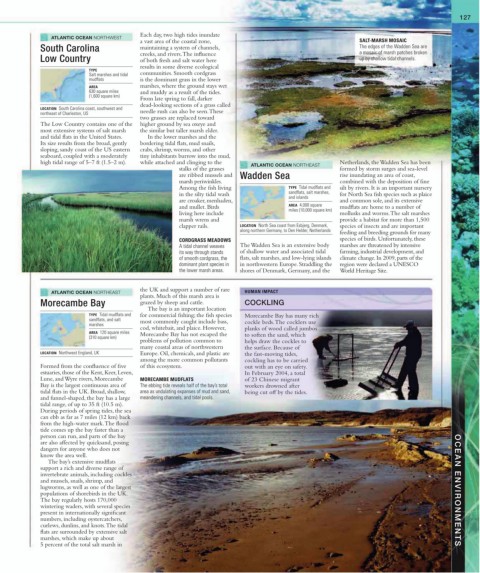
127


                ATLANTIC OCEAN NORTHWEST   Each day, two high tides inundate
                                           a vast area of the coastal zone,                                 SALT-MARSH MOSAIC
             South Carolina                maintaining a system of channels,                                The edges of the Wadden Sea are
                                           creeks, and rivers. The influence                                a mosaic of marsh patches broken
             Low Country                   of both fresh and salt water here                                up by shallow tidal channels.
                                           results in some diverse ecological
                           TYPE
                           Salt marshes and tidal   communities. Smooth cordgrass
                           mudflats         is the dominant grass in the lower
                           AREA            marshes, where the ground stays wet
                           630 square miles    and muddy as a result of the tides.
                           (1,600 square km)
                                           From late spring to fall, darker
                                           dead-looking sections of a grass called
             LOCATION  South Carolina coast, southwest and
             northeast of Charleston, US   needle rush can also be seen. These
                                           two grasses are replaced toward
             The Low Country contains one of the   higher ground by sea oxeye and
             most extensive systems of salt marsh   the similar but taller marsh elder.
             and tidal flats in the United States.    In the lower marshes and the
             Its size results from the broad, gently   bordering tidal flats, mud snails,
             sloping, sandy coast of the US eastern   crabs, shrimp, worms, and other
             seaboard, coupled with a moderately   tiny inhabitants burrow into the mud,
             high tidal range of 5–7 ft (1.5–2 m).   while attached and clinging to the   ATLANTIC OCEAN NORTHEAST  Netherlands, the Wadden Sea has been
                                                      stalks of the grasses                           formed by storm surges and sea-level
                                                      are ribbed mussels and   Wadden Sea             rise inundating an area of coast,
                                                      marsh periwinkles.                              combined with the deposition of fine
                                                      Among the fish living            TYPE  Tidal mudflats and   silt by rivers. It is an important nursery
                                                      in the silty tidal wash          sandflats, salt marshes,   for North Sea fish species such as plaice
                                                                                       and islands
                                                      are croaker, menhaden,                          and common sole, and its extensive
                                                      and mullet. Birds                AREA  4,000 square   mudflats are home to a number of
                                                                                       miles (10,000 square km)
                                                      living here include                             mollusks and worms. The salt marshes
                                                      marsh wrens and                                 provide a habitat for more than 1,500
                                                      clapper rails.    LOCATION  North Sea coast from Esbjerg, Denmark,   species of insects and are important
                                                                        along northern Germany, to Den Helder, Netherlands
                                                                                                      feeding and breeding grounds for many
                                                      CORDGRASS MEADOWS                               species of birds. Unfortunately, these
                                                      A tidal channel weaves    The Wadden Sea is an extensive body   marshes are threatened by intensive
                                                      its way through stands    of shallow water and associated tidal   farming, industrial development, and
                                                      of smooth cordgrass, the   flats, salt marshes, and low-lying islands   climate change. In 2009, parts of the
                                                      dominant plant species in   in northwestern Europe. Straddling the   region were declared a UNESCO
                                                      the lower marsh areas.  shores of Denmark, Germany, and the   World Heritage Site.

                ATLANTIC OCEAN NORTHEAST   the UK and support a number of rare   HUMAN IMPACT
                                           plants. Much of this marsh area is
             Morecambe Bay                 grazed by sheep and cattle.    COCKLING
                                             The bay is an important location
                           TYPE  Tidal mudflats and   for commercial fishing; the fish species   Morecambe Bay has many rich
                           sandflats, and salt   most commonly caught include bass,   cockle beds. The cocklers use
                           marshes
                                           cod, whitebait, and plaice. However,   planks of wood called jumbos
                           AREA  120 square miles   Morecambe Bay has not escaped the   to soften the sand, which
                           (310 square km)
                                           problems of pollution common to   helps draw the cockles to
                                           many coastal areas of northwestern   the surface. Because of
             LOCATION  Northwest England, UK  Europe. Oil, chemicals, and plastic are   the fast-moving tides,
                                           among the more common pollutants   cockling has to be carried
             Formed from the confluence of five   of this ecosystem.      out with an eye on safety.
             estuaries, those of the Kent, Keer, Leven,                   In February 2004, a total
             Lune, and Wyre rivers, Morecambe   MORECAMBE MUDFLATS        of 23 Chinese migrant
             Bay is the largest continuous area of   The ebbing tide reveals half of the bay’s total   workers drowned after
             tidal flats in the UK. Broad, shallow,   area as undulating expanses of mud and sand,   being cut off by the tides.
             and funnel-shaped, the bay has a large   meandering channels, and tidal pools.
             tidal range, of up to 35 ft (10.5 m).
             During periods of spring tides, the sea
             can ebb as far as 7 miles (12 km) back
             from the high-water mark. The flood
             tide comes up the bay faster than a
             person can run, and parts of the bay
             are also affected by quicksand, posing
             dangers for anyone who does not
             know the area well.
               The bay’s extensive mudflats
             support a rich and diverse range of
             invertebrate animals, including cockles
             and mussels, snails, shrimp, and
             lugworms, as well as one of the largest                                                                                     OCEAN ENVIRONMENTS
             populations of shorebirds in the UK.
             The bay regularly hosts 170,000
             wintering waders, with several species
             present in internationally significant
             numbers, including oystercatchers,
             curlews, dunlins, and knots. The tidal
             flats are surrounded by extensive salt
             marshes, which make up about
             5 percent of the total salt marsh in

