


Page 126 - (DK) Ocean - The Definitive Visual Guide
P. 126
124     COASTS AND THE SEASHORE


               Salt Marshes and Tidal Flats


               A SALT MARSH IS A VEGETATED AREA OF COAST that is partly flooded
               by the sea at high tide and completely flooded by the highest
               spring tides. Many areas of salt marsh are bordered by tidal flats.
               These are broad areas of mud or sand, mainly without
               vegetation, that are uncovered at low tide and covered as the
               tide rises. Salt marshes and tidal flats are depositories for large   PA CIFIC       ATLANTIC OCEAN
               amounts of organic material, derived from decaying plants and        OCEAN
                                                                                                                  INDIAN
               animals. This provides the base for an extensive food chain.
                                                                                                                  OCEAN
                                                                                                 S O U T H E R N   O C E A N
               Formation and Features

               Tidal flats occur on low-energy sheltered coasts, such as estuaries and enclosed bays, where   DISTRIBUTION
               sediment held in the water settles out and builds up. The most extensive flats occur where   Salt marshes and tidal flats occur only north
                                                                                          of the latitude of 32˚N and south of 38˚S.
               there is a high tidal range. Tidal flats may consist either of sand (sandflats) or mud (mudflats),
                                                                                          In latitudes nearer the equator, they are
               or a mixture of these. Mudflats contain a higher concentration of the decaying remains    replaced by mangrove swamps.
               of dead organisms than sandflats and are also the first stage in the
               development of salt marshes. These develop on the landward side                                       COASTAL SETTING
               of mudflats. As various salt-tolerant plants grow, their roots trap sediment   river delta            Salt marshes commonly
                                             and stabilize the mud. As the                        estuary            develop in coastal
                                             vegetated flat builds up, different                                     lagoons or in estuarine
                                                                                                                     areas that are sheltered
                                             types of plants become established.   mainland           mainland       from the sea by spits
                                             The result is a salt marsh, consisting                                  or barrier islands.
                                             of blocks of flat, low-growing                           channels       The channels transport
                                             vegetated areas of mud, broken up                                       salt water, plankton,
                                             by sinuous channels.                                                    nutrients, sediment, and
                                                                                         flood delta                  plant detritus into and
                                                                                                                     out of the marsh.
                                             BAY OF FUNDY
                                             In this small sub-estuary of Canada’s
                                             Bay of Fundy, an area of salt marsh is   dunes  barrier island  dunes   KEY
                                             visible in the background. In the                                            salt marsh
                                             foreground is a broad intertidal area   ebb delta  inlet  lagoon
                                             of mud and gravel.                                                           tidal flats


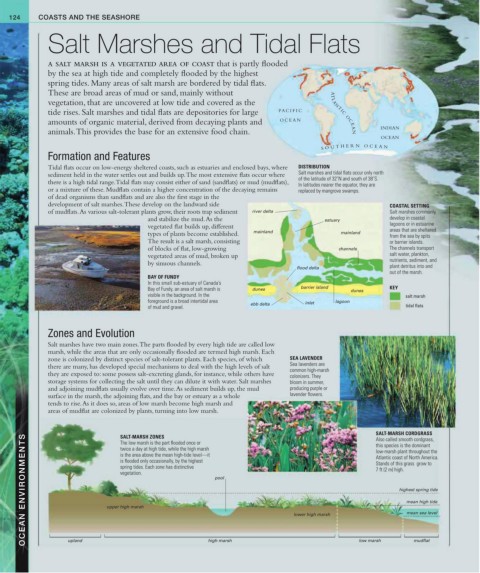
               Zones and Evolution

               Salt marshes have two main zones. The parts flooded by every high tide are called low
               marsh, while the areas that are only occasionally flooded are termed high marsh. Each
               zone is colonized by distinct species of salt-tolerant plants. Each species, of which   SEA LAVENDER
               there are many, has developed special mechanisms to deal with the high levels of salt   Sea lavenders are
                                                                                       common high-marsh
               they are exposed to: some possess salt-excreting glands, for instance, while others have   colonizers. They
               storage systems for collecting the salt until they can dilute it with water. Salt marshes   bloom in summer,
               and adjoining mudflats usually evolve over time. As sediment builds up, the mud   producing purple or
               surface in the marsh, the adjoining flats, and the bay or estuary as a whole   lavender flowers.
               tends to rise. As it does so, areas of low marsh become high marsh and
               areas of mudflat are colonized by plants, turning into low marsh.


                                                                                                                 SALT-MARSH CORDGRASS
        OCEAN ENVIRONMENTS  upland  upper high marsh           high marsh               lower high marsh    low marsh   highest spring tide
                                     SALT-MARSH ZONES
                                                                                                                 Also called smooth cordgrass,
                                     The low marsh is the part flooded once or
                                                                                                                 this species is the dominant
                                     twice a day at high tide, while the high marsh
                                                                                                                 low-marsh plant throughout the
                                     is the area above the mean high-tide level—it
                                                                                                                 Atlantic coast of North America.
                                     is flooded only occasionally, by the highest
                                                                                                                 Stands of this grass  grow to
                                     spring tides. Each zone has distinctive
                                                                                                                 7 ft (2 m) high.
                                     vegetation.
                                                                 pool
                                                                                                                          mean high tide
                                                                                                                          mean sea level

                                                                                                                            mudflat

