


Page 127 - (DK) Ocean - The Definitive Visual Guide
P. 127
125


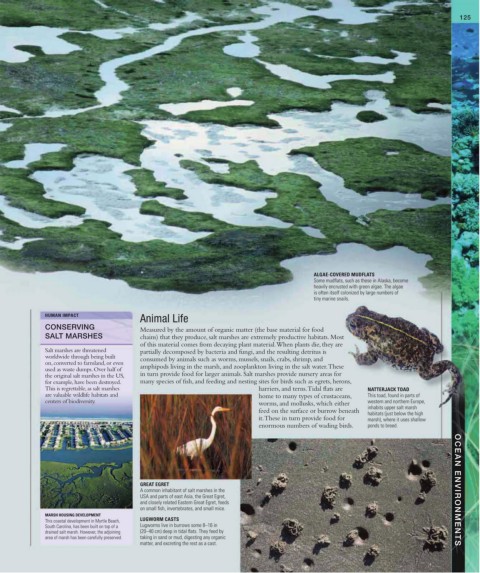
                                                                                              ALGAE-COVERED MUDFLATS
                                                                                              Some mudflats, such as these in Alaska, become
                                                                                              heavily encrusted with green algae. The algae
                                                                                              is often itself colonized by large numbers of
                                                                                              tiny marine snails.

              HUMAN IMPACT
                                           Animal Life
              CONSERVING                   Measured by the amount of organic matter (the base material for food
              SALT MARSHES                 chains) that they produce, salt marshes are extremely productive habitats. Most
                                           of this material comes from decaying plant material. When plants die, they are
              Salt marshes are threatened   partially decomposed by bacteria and fungi, and the resulting detritus is
              worldwide through being built    consumed by animals such as worms, mussels, snails, crabs, shrimp, and
              on, converted to farmland, or even
              used as waste dumps. Over half of   amphipods living in the marsh, and zooplankton living in the salt water. These
              the original salt marshes in the US,   in turn provide food for larger animals. Salt marshes provide nursery areas for
              for example, have been destroyed.   many species of fish, and feeding and nesting sites for birds such as egrets, herons,
              This is regrettable, as salt marshes                            harriers, and terns. Tidal flats are   NATTERJACK TOAD
              are valuable wildlife habitats and                              home to many types of crustaceans,   This toad, found in parts of
              centers of biodiversity.                                                                         western and northern Europe,
                                                                              worms, and mollusks, which either
                                                                              feed on the surface or burrow beneath   inhabits upper salt marsh
                                                                                                               habitats (just below the high
                                                                              it. These in turn provide food for   marsh), where it uses shallow
                                                                              enormous numbers of wading birds.  ponds to breed.


                                           GREAT EGRET
                                           A common inhabitant of salt marshes in the                                                    OCEAN ENVIRONMENTS
                                           USA and parts of east Asia, the Great Egret,
                                           and closely related Eastern Great Egret, feeds
                                           on small fish, invertebrates, and small mice.
              MARSH HOUSING DEVELOPMENT
              This coastal development in Myrtle Beach,   LUGWORM CASTS
              South Carolina, has been built on top of a   Lugworms live in burrows some 8–16 in
              drained salt marsh. However, the adjoining   (20–40 cm) deep in tidal flats. They feed by
              area of marsh has been carefully preserved.   taking in sand or mud, digesting any organic
                                           matter, and excreting the rest as a cast.

