


Page 125 - (DK) Ocean - The Definitive Visual Guide
P. 125
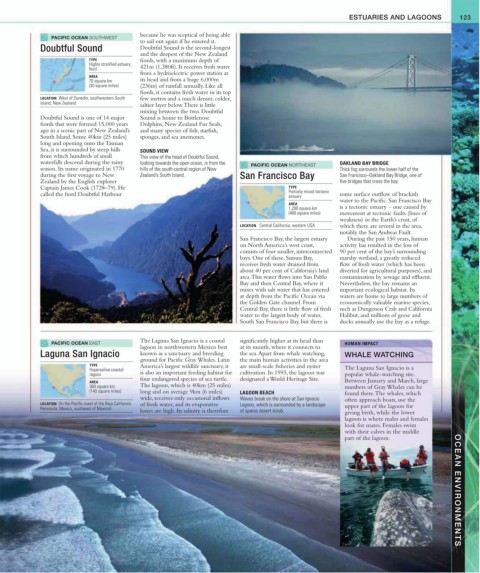
ESTUARIES AND LAGOONS            123


                PACIFIC OCEAN SOUTHWEST    because he was sceptical of being able
                                           to sail out again if he entered it.
             Doubtful Sound                Doubtful Sound is the second-longest
                                           and the deepest of the New Zealand
                           TYPE            fiords, with a maximum depth of
                           Highly stratified estuary;
                           fiord            421m (1,380ft). It receives fresh water
                                           from a hydroelectric power station at
                           AREA
                           70 square km    its head and from a huge 6,000m
                           (30 square miles)   (236in) of rainfall annually. Like all
                                           fiords, it contains fresh water in its top
             LOCATION  West of Dunedin, southwestern South   few metres and a much denser, colder,
             Island, New Zealand           saltier layer below. There is little
                                           mixing between the two. Doubtful
             Doubtful Sound is one of 14 major   Sound is home to Bottlenose
             fiords that were formed 15,000 years   Dolphins, New Zealand Fur Seals,
             ago in a scenic part of New Zealand’s   and many species of fish, starfish,
             South Island. Some 40km (25 miles)   sponges, and sea anemones.
             long and opening onto the Tasman
             Sea, it is surrounded by steep hills   SOUND VIEW
             from which hundreds of small   This view of the head of Doubtful Sound,
             waterfalls descend during the rainy   looking towards the open ocean, is from the   PACIFIC OCEAN NORTHEAST  OAKLAND BAY BRIDGE
             season. Its name originated in 1770   hills of the south-central region of New           Thick fog surrounds the lower half of the
             during the first voyage to New   Zealand’s South Island.   San Francisco Bay             San Francisco–Oakland Bay Bridge, one of
             Zealand by the English explorer                                                          five bridges that cross the bay.
             Captain James Cook (1728–79). He                                          TYPE
             called the fiord Doubtful Harbour                                         Partially mixed tectonic   some surface outflow of brackish
                                                                                       estuary
                                                                                                      water to the Pacific. San Francisco Bay
                                                                                       AREA
                                                                                       1,200 square km    is a tectonic estuary – one caused by
                                                                                       (460 square miles)   movement at tectonic faults (lines of
                                                                                                      weakness) in the Earth’s crust, of
                                                                        LOCATION   Central California, western USA  which there are several in the area,
                                                                                                      notably the San Andreas Fault.
                                                                        San Francisco Bay, the largest estuary   During the past 150 years, human
                                                                        on North America’s west coast,   activity has resulted in the loss of
                                                                        consists of four smaller, interconnected   90 per cent of the bay’s surrounding
                                                                        bays. One of these, Suisun Bay,   marshy wetland, a greatly reduced
                                                                        receives fresh water drained from   flow of fresh water (which has been
                                                                        about 40 per cent of California’s land   diverted for agricultural purposes), and
                                                                        area. This water flows into San Pablo   contamination by sewage and effluent.
                                                                        Bay and then Central Bay, where it   Nevertheless, the bay remains an
                                                                        mixes with salt water that has entered   important ecological habitat. Its
                                                                        at depth from the Pacific Ocean via   waters are home to large numbers of
                                                                        the Golden Gate channel. From   economically valuable marine species,
                                                                        Central Bay, there is little flow of fresh   such as Dungeness Crab and California
                                                                        water to the largest body of water,   Halibut, and millions of geese and
                                                                        South San Francisco Bay, but there is   ducks annually use the bay as a refuge.


                PACIFIC OCEAN EAST         The Laguna San Ignacio is a coastal   significantly higher at its head than    HUMAN IMPACT
                                           lagoon in northwestern Mexico best   at its mouth, where it connects to
             Laguna San Ignacio            known as a sanctuary and breeding   the sea. Apart from whale watching,    WHALE WATCHING
                                           ground for Pacific Gray Whales. Latin   the main human activities in the area
                            TYPE           America’s largest wildlife sanctuary, it   are small-scale fisheries and oyster
                            Hypersaline coastal                                                         The Laguna San Ignacio is a
                            lagoon         is also an important feeding habitat for   cultivation. In 1993, the lagoon was   popular whale-watching site.
                                           four endangered species of sea turtle.   designated a World Heritage Site.
                            AREA                                                                        Between January and March, large
                            360 square km    The lagoon, which is 40km (25 miles)                       numbers of Gray Whales can be
                            (140 square miles)   long and on average 9km (6 miles)   LAGOON BEACH       found there. The whales, which
                                           wide, receives only occasional inflows   Waves break on the shore at San Ignacio   often approach boats, use the
             LOCATION  On the Pacific coast of the Baja California   of fresh water, and its evaporative   Lagoon, which is surrounded by a landscape
             Peninsula, Mexico, southeast of Mexicali                                                   upper part of the lagoon for
                                           losses are high. Its salinity is therefore   of sparse desert scrub.   giving birth, while the lower
                                                                                                        lagoon is where males and females
                                                                                                        look for mates. Females swim
                                                                                                        with their calves in the middle
                                                                                                        part of the lagoon.              OCEAN ENVIRONMENTS

