


Page 128 - (DK) Ocean - The Definitive Visual Guide
P. 128
126
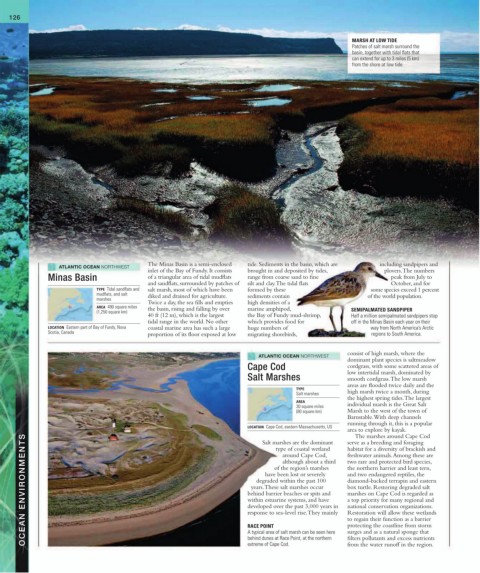
MARSH AT LOW TIDE
Patches of salt marsh surround the
basin, together with tidal flats that
can extend for up to 3 miles (5 km)
from the shore at low tide.
ATLANTIC OCEAN NORTHWEST The Minas Basin is a semi-enclosed tide. Sediments in the basin, which are including sandpipers and
inlet of the Bay of Fundy. It consists brought in and deposited by tides, plovers. The numbers
Minas Basin of a triangular area of tidal mudflats range from coarse sand to fine peak from July to
and sandflats, surrounded by patches of silt and clay. The tidal flats October, and for
TYPE Tidal sandflats and salt marsh, most of which have been formed by these some species exceed 1 percent
mudflats, and salt diked and drained for agriculture. sediments contain of the world population.
marshes
Twice a day, the sea fills and empties high densities of a
AREA 490 square miles the basin, rising and falling by over marine amphipod,
(1,250 square km) SEMIPALMATED SANDPIPER
40 ft (12 m), which is the largest the Bay of Fundy mud-shrimp, Half a million semipalmated sandpipers stop
tidal range in the world. No other which provides food for off in the Minas Basin each year on their
LOCATION Eastern part of Bay of Fundy, Nova coastal marine area has such a large huge numbers of way from North America’s Arctic
Scotia, Canada proportion of its floor exposed at low migrating shorebirds, regions to South America.
ATLANTIC OCEAN NORTHWEST consist of high marsh, where the
dominant plant species is saltmeadow
Cape Cod cordgrass, with some scattered areas of
low intertidal marsh, dominated by
Salt Marshes smooth cordgrass. The low marsh
areas are flooded twice daily and the
TYPE
Salt marshes high marsh twice a month, during
the highest spring tides. The largest
AREA
30 square miles individual marsh is the Great Salt
(80 square km) Marsh to the west of the town of
Barnstable. With deep channels
running through it, this is a popular
LOCATION Cape Cod, eastern Massachusetts, US
area to explore by kayak.
The marshes around Cape Cod
OCEAN ENVIRONMENTS behind barrier beaches or spits and two rare and protected bird species,
serve as a breeding and foraging
Salt marshes are the dominant
habitat for a diversity of brackish and
type of coastal wetland
around Cape Cod,
freshwater animals. Among these are
although about a third
the northern harrier and least tern,
of the region’s marshes
and two endangered reptiles, the
have been lost or severely
diamond-backed terrapin and eastern
degraded within the past 100
box turtle. Restoring degraded salt
years. These salt marshes occur
marshes on Cape Cod is regarded as
within estuarine systems, and have
a top priority for many regional and
developed over the past 3,000 years in
national conservation organizations.
response to sea-level rise. They mainly
Restoration will allow these wetlands
to regain their function as a barrier
protecting the coastline from storm
RACE POINT
surges and as a natural sponge that
A typical area of salt marsh can be seen here
filters pollutants and excess nutrients
behind dunes at Race Point, at the northern
extreme of Cape Cod.
from the water runoff in the region.

