


Page 224 - (DK) Ocean - The Definitive Visual Guide
P. 224
222     INTRODUCTION TO OCEAN LIFE


               Living Down Deep


               THE DEEP-SEA ENVIRONMENT APPEARS INHOSPITABLE—cold, dark, and with little
               food. However, it is remarkably stable: temperatures remain between 35 and 39ºF
               (2 and 4ºC) year-round, salinity is constant, and the perpetual darkness is overcome
               by novel communication methods (see pp.224–225). Although deep-sea pressures are
               immense, most marine animals are unaffected, since they have
               no air spaces, while animals living below about 5,000 ft
               (1,500 m) show subtle adaptations. Species diversity
               of large animals decreases with depth, but
               there is a huge diversity of small
               organisms living within
               deep-sea sediments.


                                                                                                            Pressure Problems
                                                                                                         Deep-ocean animals experience
                                                                                                       huge pressures, but problems arise
                                                                                                     only in gas-filled organs such as
                                                                                                    the lungs of diving mammals and
                                                                                                 the swim bladders of fish. Sperm whales,
                                                                                              Weddell seals, and elephant seals all dive to
                                                                                            depths where their lungs are compressed, but
                                                                                          their flexible rib cages allow this. While underwater,
                                                                                          they use oxygen stored in blood and muscles.
                                                                                          Deep-sea fish can cover a large vertical range
                                                                                          because pressure changes at depth are proportionately
                                                                                          less, per foot, than near the surface, so the pressure or
                                                                                          size of their swim bladders does not change radically.
                                                                                          In oceanic trenches, the pressure is so great that it
        OCEAN LIFE  DEEP-SEA ADAPTATIONS                                                  as proteins. Pressure-loving bacteria in this habitat
                                                                                          affects the operation of biological molecules, such
                                                                                                              have specialized
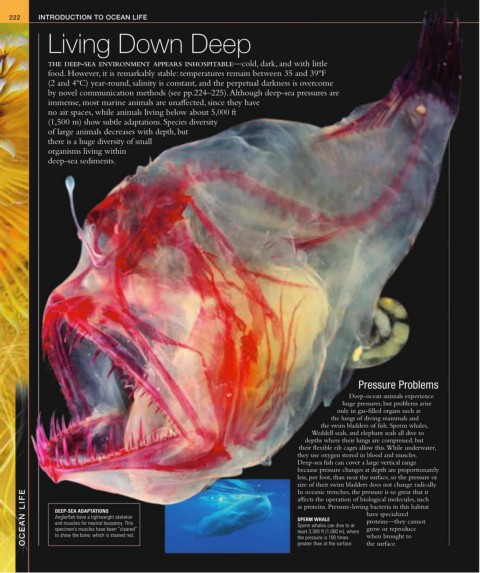
                 Anglerfish have a lightweight skeleton
                                                                                          SPERM WHALE
                                                                                                              proteins—they cannot
                 and muscles for neutral buoyancy. This
                                                                                          Sperm whales can dive to at
                                                                                                              grow or reproduce
                 specimen’s muscles have been “cleared”
                                                                                          least 3,300 ft (1,000 m), where
                 to show the bone, which is stained red.
                                                                                                              when brought to
                                                                                          the pressure is 100 times
                                                                                                              the surface.
                                                                                          greater than at the surface.

