


Page 265 - (DK) Ocean - The Definitive Visual Guide
P. 265
CNIDARIANS        263


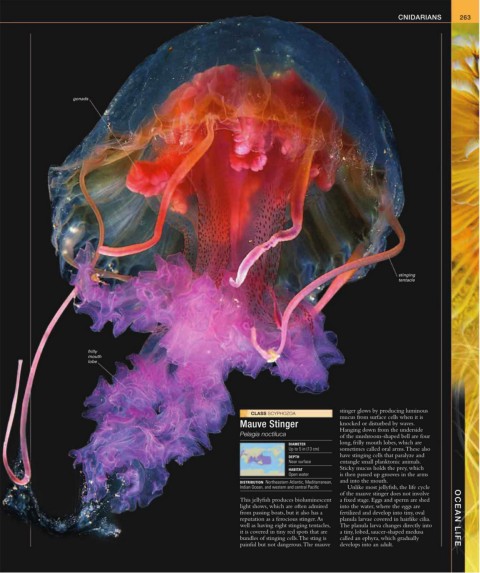
                       gonads


                                                                                                                        stinging
                                                                                                                        tentacle


                           frilly
                           mouth
                           lobe


                                                                                                      stinger glows by producing luminous
                                                                            CLASS SCYPHOZOA
                                                                                                      mucus from surface cells when it is
                                                                        Mauve Stinger                 knocked or disturbed by waves.
                                                                                                      Hanging down from the underside
                                                                                                      of the mushroom-shaped bell are four
                                                                        Pelagia noctiluca
                                                                                       DIAMETER       long, frilly mouth lobes, which are
                                                                                       Up to 5 in (13 cm)  sometimes called oral arms. These also
                                                                                       DEPTH          have stinging cells that paralyze and
                                                                                       Near surface   entangle small planktonic animals.
                                                                                       HABITAT        Sticky mucus holds the prey, which
                                                                                       Open water     is then passed up grooves in the arms
                                                                        DISTRIBUTION  Northeastern Atlantic, Mediterranean,   and into the mouth.
                                                                        Indian Ocean, and western and central Pacific  Unlike most jellyfish, the life cycle
                                                                                                      of the mauve stinger does not involve
                                                                        This jellyfish produces bioluminescent   a fixed stage. Eggs and sperm are shed
                                                                        light shows, which are often admired   into the water, where the eggs are
                                                                        from passing boats, but it also has a   fertilized and develop into tiny, oval
                                                                        reputation as a ferocious stinger. As   planula larvae covered in hairlike cilia.   OCEAN LIFE
                                                                        well as having eight stinging tentacles,   The planula larva changes directly into
                                                                        it is covered in tiny red spots that are   a tiny, lobed, saucer-shaped medusa
                                                                        bundles of stinging cells. The sting is   called an ephyra, which gradually
                                                                        painful but not dangerous. The mauve   develops into an adult.

