Page 263 - (DK) Ocean - The Definitive Visual Guide
P. 263
CNIDARIANS        261


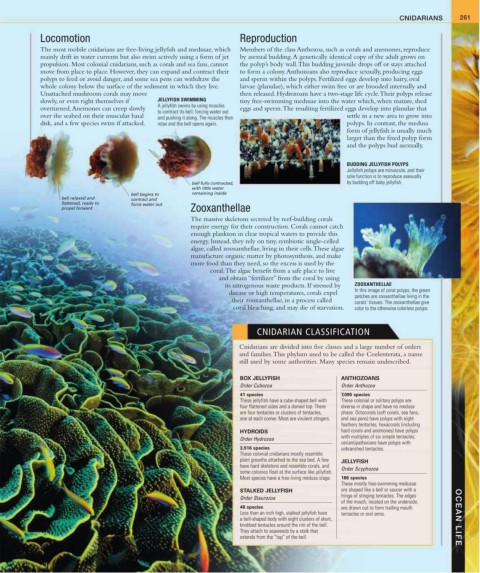
             Locomotion                                                 Reproduction

             The most mobile cnidarians are free-living jellyfish and medusae, which   Members of the class Anthozoa, such as corals and anemones, reproduce
             mainly drift in water currents but also swim actively using a form of jet   by asexual budding. A genetically identical copy of the adult grows on
             propulsion. Most colonial cnidarians, such as corals and sea fans, cannot   the polyp’s body wall. This budding juvenile drops off or stays attached
             move from place to place. However, they can expand and contract their   to form a colony. Anthozoans also reproduce sexually, producing eggs
             polyps to feed or avoid danger, and some sea pens can withdraw the   and sperm within the polyps. Fertilized eggs develop into hairy, oval
             whole colony below the surface of the sediment in which they live.   larvae (planulae), which either swim free or are brooded internally and
             Unattached mushroom corals may move                        then released. Hydrozoans have a two-stage life cycle. Their polyps release
             slowly, or even right themselves if    JELLYFISH SWIMMING  tiny free-swimming medusae into the water which, when mature, shed
                                                A jellyfish swims by using muscles
             overturned. Anemones can creep slowly                      eggs and sperm. The resulting fertilized eggs develop into planulae that
                                                to contract its bell, forcing water out
             over the seabed on their muscular basal   and pushing it along. The muscles then           settle in a new area to grow into
             disk, and a few species swim if attacked.  relax and the bell opens again.                 polyps. In contrast, the medusa
                                                                                                        form of jellyfish is usually much
                                                                                                        larger than the fixed polyp form
                                                                                                        and the polyps bud asexually.


                                                                                                        BUDDING JELLYFISH POLYPS
                                                                                                        Jellyfish polyps are minuscule, and their
                                                                                                        sole function is to reproduce asexually
                                                          bell fully contracted,                        by budding off baby jellyfish.
                                                          with little water
                                        bell begins to    remaining inside
                   bell relaxed and     contract and
                   flattened, ready to   force water out
                   propel forward                         Zooxanthellae
                                                          The massive skeletons secreted by reef-building corals
                                                          require energy for their construction. Corals cannot catch
                                                          enough plankton in clear tropical waters to provide this
                                                          energy. Instead, they rely on tiny, symbiotic single-celled
                                                          algae, called zooxanthellae, living in their cells. These algae
                                                          manufacture organic matter by photosynthesis, and make
                                                          more food than they need, so the excess is used by the
                                                                coral. The algae benefit from a safe place to live
                                                                  and obtain “fertilizer” from the coral by using
                                                                    its nitrogenous waste products. If stressed by   ZOOXANTHELLAE
                                                                     disease or high temperatures, corals expel   In this image of coral polyps, the green
                                                                                                           patches are zooxanthellae living in the
                                                                      their zooxanthellae, in a process called    corals’ tissues. The zooxanthellae give
                                                                      coral bleaching, and may die of starvation.  color to the otherwise colorless polyps.


                                                                             CNIDARIAN CLASSIFICATION

                                                                        Cnidarians are divided into five classes and a large number of orders
                                                                        and families. This phylum used to be called the Coelenterata, a name
                                                                        still used by some authorities. Many species remain undescribed.


                                                                        BOX JELLYFISH                  ANTHOZOANS
                                                                        Order Cubozoa                  Order Anthozoa
                                                                        41 species                     7,095 species
                                                                        These jellyfish have a cube-shaped bell with   These colonial or solitary polyps are
                                                                        four flattened sides and a domed top. There   diverse in shape and have no medusa
                                                                        are four tentacles or clusters of tentacles,    phase. Octocorals (soft corals, sea fans,
                                                                        one at each corner. Most are virulent stingers.  and sea pens) have polyps with eight
                                                                                                       feathery tentacles; hexacorals (including
                                                                                                       hard corals and anemones) have polyps
                                                                        HYDROIDS
                                                                        Order Hydrozoa                 with multiples of six simple tentacles;
                                                                                                       ceriantipatharians have polyps with
                                                                                                       unbranched tentacles.
                                                                        3,516 species
                                                                        These colonial cnidarians mostly resemble
                                                                        plant growths attached to the sea bed. A few
                                                                                                       JELLYFISH
                                                                        have hard skeletons and resemble corals, and   Order Scyphozoa
                                                                        some colonies float at the surface like jellyfish.
                                                                        Most species have a free-living medusa stage.  186 species
                                                                                                       These mostly free-swimming medusae
                                                                                                       are shaped like a bell or saucer with a
                                                                        STALKED JELLYFISH
                                                                        Order Staurozoa                fringe of stinging tentacles. The edges
                                                                                                       of the mouth, located on the underside,
                                                                                                       are drawn out to form trailing mouth
                                                                        48 species
                                                                        Less than an inch high, stalked jellyfish have    tentacles or oral arms.
                                                                        a bell-shaped body with eight clusters of short,                 OCEAN LIFE
                                                                        knobbed tentacles around the rim of the bell.
                                                                        They attach to seaweeds by a stalk that
                                                                        extends from the “top” of the bell.
   258   259   260   261   262   263   264   265   266   267   268