Page 264 - (DK) Ocean - The Definitive Visual Guide
P. 264
262


                                                                                                            CLASS HYDROZOA
                                                                                                        Blue Buttons

                                                                                                        Porpita porpita
                                                                                                                       DIAMETER
                                                                                                                       3 / 4 in (2 cm)
                                                                                                                       DEPTH
                                                                                                                       Surface
                                                                                                                       HABITAT
                                                                                                                       Surface waters
                                                                                                        DISTRIBUTION  Worldwide in warm waters
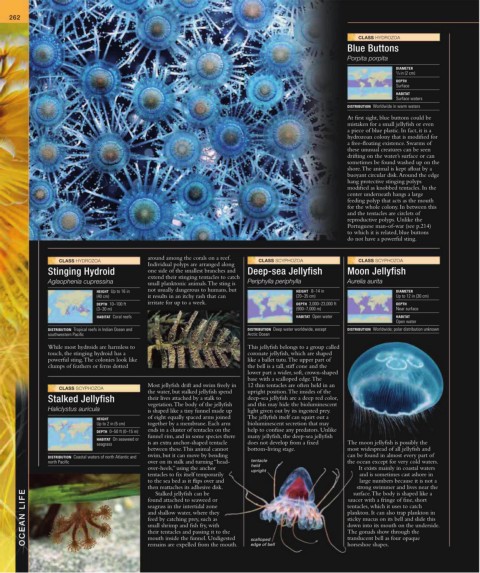
                                                                                                        At first sight, blue buttons could be
                                                                                                        mistaken for a small jellyfish or even
                                                                                                        a piece of blue plastic. In fact, it is a
                                                                                                        hydrozoan colony that is modified for
                                                                                                        a free-floating existence. Swarms of
                                                                                                        these unusual creatures can be seen
                                                                                                        drifting on the water’s surface or can
                                                                                                        sometimes be found washed up on the
                                                                                                        shore. The animal is kept afloat by a
                                                                                                        buoyant circular disk. Around the edge
                                                                                                        hang protective stinging polyps
                                                                                                        modified as knobbed tentacles. In the
                                                                                                        center underneath hangs a large
                                                                                                        feeding polyp that acts as the mouth
                                                                                                        for the whole colony. In between this
                                                                                                        and the tentacles are circlets of
                                                                                                        reproductive polyps. Unlike the
                                                                                                        Portuguese man-of-war (see p.214)
                                                                                                        to which it is related, blue buttons
                                                                                                        do not have a powerful sting.


                  CLASS HYDROZOA             around among the corals on a reef.   CLASS SCYPHOZOA           CLASS SCYPHOZOA
                                             Individual polyps are arranged along
               Stinging Hydroid              one side of the smallest branches and   Deep-sea Jellyfish  Moon Jellyfish
                                             extend their stinging tentacles to catch
               Aglaophenia cupressina        small planktonic animals. The sting is   Periphylla periphylla   Aurelia aurita
                              HEIGHT  Up to 16 in   not usually dangerous to humans, but   HEIGHT   8–14 in            DIAMETER
                              (40 cm)        it results in an itchy rash that can        (20–35 cm)                    Up to 12 in (30 cm)
                              DEPTH  10–100 ft   irritate for up to a week.              DEPTH  3,000–23,000 ft        DEPTH
                              (3–30 m)                                                   (900–7,000 m)                 Near surface
                              HABITAT  Coral reefs                                       HABITAT  Open water           HABITAT
                                                                                                                       Open water
               DISTRIBUTION  Tropical reefs in Indian Ocean and            DISTRIBUTION  Deep water worldwide, except    DISTRIBUTION  Worldwide; polar distribution unknown
               southwestern Pacific                                         Arctic Ocean
               While most hydroids are harmless to                         This jellyfish belongs to a group called
               touch, the stinging hydroid has a                           coronate jellyfish, which are shaped
               powerful sting. The colonies look like                      like a ballet tutu. The upper part of
               clumps of feathers or ferns dotted                          the bell is a tall, stiff cone and the
                                                                           lower part a wider, soft, crown-shaped
                                                                           base with a scalloped edge. The
                                             Most jellyfish drift and swim freely in   12 thin tentacles are often held in an
                  CLASS SCYPHOZOA
                                             the water, but stalked jellyfish spend   upright position. The insides of the
               Stalked Jellyfish             their lives attached by a stalk to   deep-sea jellyfish are a deep red color,
                                             vegetation. The body of the jellyfish    and this may hide the bioluminescent
                                             is shaped like a tiny funnel made up   light given out by its ingested prey.
               Haliclystus auricula
                                             of eight equally spaced arms joined   The jellyfish itself can squirt out a
                              HEIGHT
                              Up to 2 in (5 cm)  together by a membrane. Each arm   bioluminescent secretion that may
                              DEPTH  0–50 ft (0–15 m)  ends in a cluster of tentacles on the   help to confuse any predators. Unlike
                                             funnel rim, and in some species there   many jellyfish, the deep-sea jellyfish
                              HABITAT  On seaweed or
                              seagrass       is an extra anchor-shaped tentacle   does not develop from a fixed   The moon jellyfish is possibly the
                                             between these. This animal cannot   bottom-living stage.   most widespread of all jellyfish and
               DISTRIBUTION  Coastal waters of north Atlantic and   swim, but it can move by bending    can be found in almost every part of
               north Pacific                  over on its stalk and turning “head-   tentacle            the ocean except for very cold waters.
                                             over-heels,” using the anchor   held                           It exists mainly in coastal waters
                                                                            upright
                                             tentacles to fix itself temporarily                            and is sometimes cast ashore in
                                             to the sea bed as it flips over and                            large numbers because it is not a
                                                                                                           strong swimmer and lives near the
                                             then reattaches its adhesive disk.                          saucer with a fringe of fine, short
        OCEAN LIFE                           seagrass in the intertidal zone   scalloped                tentacles, which it uses to catch
                                               Stalked jellyfish can be
                                                                                                          surface. The body is shaped like a
                                             found attached to seaweed or
                                                                                                        plankton. It can also trap plankton in
                                             and shallow water, where they
                                             feed by catching prey, such as
                                                                                                        sticky mucus on its bell and slide this
                                                                                                        down into its mouth on the underside.
                                             small shrimp and fish fry, with
                                             their tentacles and passing it to the
                                                                                                        The gonads show through the
                                                                                                        translucent bell as four opaque
                                             mouth inside the funnel. Undigested
                                             remains are expelled from the mouth.
                                                                                                        horseshoe shapes.
                                                                            edge of bell
   259   260   261   262   263   264   265   266   267   268   269