


Page 266 - (DK) Ocean - The Definitive Visual Guide
P. 266
264 ANIMAL LIFE
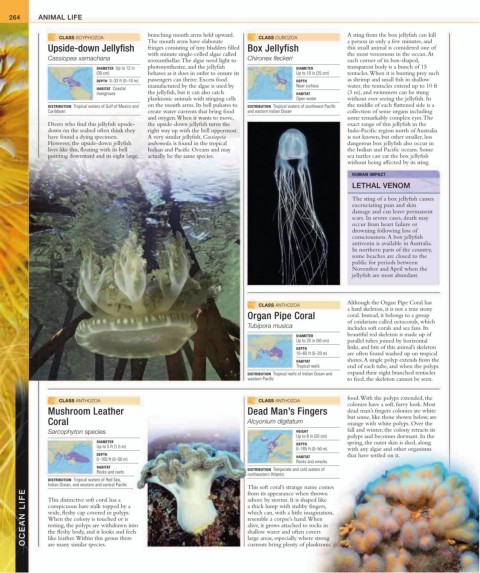
CLASS SCYPHOZOA branching mouth arms held upward. CLASS CUBOZOA A sting from the box jellyfish can kill
The mouth arms have elaborate a person in only a few minutes, and
Upside-down Jellyfish fringes consisting of tiny bladders filled Box Jellyfish this small animal is considered one of
with minute single-celled algae called the most venomous in the ocean. At
Cassiopea xamachana zooxanthellae. The algae need light to Chironex fleckeri each corner of its box-shaped,
DIAMETER Up to 12 in photosynthesize, and the jellyfish DIAMETER transparent body is a bunch of 15
(30 cm) behaves as it does in order to ensure its Up to 10 in (25 cm) tentacles. When it is hunting prey such
DEPTH 0–33 ft (0–10 m) passengers can thrive. Excess food DEPTH as shrimp and small fish in shallow
manufactured by the algae is used by Near surface water, the tentacles extend up to 10 ft
HABITAT Coastal
mangroves the jellyfish, but it can also catch HABITAT (3 m), and swimmers can be stung
planktonic animals with stinging cells Open water without ever seeing the jellyfish. In
DISTRIBUTION Tropical waters of Gulf of Mexico and on the mouth arms. Its bell pulsates to DISTRIBUTION Tropical waters of southwest Pacific the middle of each flattened side is a
Caribbean create water currents that bring food and eastern Indian Ocean collection of sense organs including
and oxygen. When it wants to move, some remarkably complex eyes. The
Divers who find this jellyfish upside- the upside-down jellyfish turns the exact range of this jellyfish in the
down on the seabed often think they right way up with the bell uppermost. Indo-Pacific region north of Australia
have found a dying specimen. A very similar jellyfish, Cassiopeia is not known, but other smaller, less
However, the upside-down jellyfish andromeda, is found in the tropical dangerous box jellyfish also occur in
lives like this, floating with its bell Indian and Pacific Oceans and may the Indian and Pacific oceans. Some
pointing downward and its eight large, actually be the same species. sea turtles can eat the box jellyfish
without being affected by its sting.
HUMAN IMPACT
LETHAL VENOM
The sting of a box jellyfish causes
excruciating pain and skin
damage and can leave permanent
scars. In severe cases, death may
occur from heart failure or
drowning following loss of
consciousness. A box jellyfish
antivenin is available in Australia.
In northern parts of the country,
some beaches are closed to the
public for periods between
November and April when the
jellyfish are most abundant.
CLASS ANTHOZOA Although the Organ Pipe Coral has
a hard skeleton, it is not a true stony
Organ Pipe Coral coral. Instead, it belongs to a group
of cnidarians called octocorals, which
Tubipora musica includes soft corals and sea fans. Its
DIAMETER beautiful red skeleton is made up of
Up to 20 in (50 cm) parallel tubes joined by horizontal
DEPTH links, and bits of this animal’s skeleton
15–65 ft (5–20 m) are often found washed up on tropical
HABITAT shores. A single polyp extends from the
Tropical reefs end of each tube, and when the polyps
DISTRIBUTION Tropical reefs of Indian Ocean and expand their eight branched tentacles
western Pacific to feed, the skeleton cannot be seen.
food. With the polyps extended, the
CLASS ANTHOZOA CLASS ANTHOZOA
colonies have a soft, furry look. Most
Mushroom Leather Dead Man’s Fingers dead man’s fingers colonies are white
Coral Alcyonium digitatum but some, like those shown below, are
orange with white polyps. Over the
Sarcophyton species HEIGHT fall and winter, the colony retracts its
Up to 8 in (20 cm) polyps and becomes dormant. In the
DIAMETER DEPTH spring, the outer skin is shed, along
Up to 5 ft (1.5 m)
0–165 ft (0–50 m) with any algae and other organisms
DEPTH HABITAT that have settled on it.
0–165 ft (0–50 m)
Rocks and wrecks
HABITAT DISTRIBUTION Temperate and cold waters of
Rocks and reefs
northeastern Atlantic
DISTRIBUTION Tropical waters of Red Sea,
Indian Ocean, and western and central Pacific
This soft coral’s strange name comes
OCEAN LIFE conspicuous bare stalk topped by a a thick lump with stubby fingers,
from its appearance when thrown
This distinctive soft coral has a
ashore by storms. It is shaped like
wide, fleshy cap covered in polyps.
which can, with a little imagination,
resemble a corpse’s hand. When
When the colony is touched or is
resting, the polyps are withdrawn into
alive, it grows attached to rocks in
the fleshy body, and it looks and feels
shallow water and often covers
large areas, especially where strong
like leather. Within this genus there
currents bring plenty of planktonic
are many similar species.

