


Page 267 - (DK) Ocean - The Definitive Visual Guide
P. 267
CNIDARIANS 265
CLASS ANTHOZOA
Carnation Coral
Dendronephthya species
HEIGHT
Up to 12 in (30 cm)
DEPTH
33–165 ft (10–50 m)
HABITAT
Coral reefs
DISTRIBUTION Tropical reefs of Red Sea, Indian
Ocean, and western Pacific
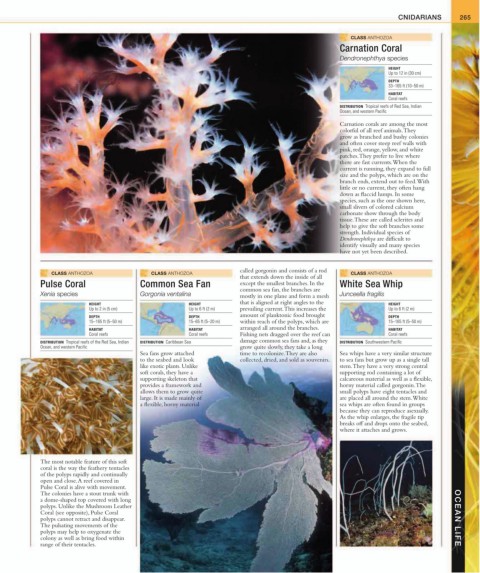
Carnation corals are among the most
colorful of all reef animals. They
grow as branched and bushy colonies
and often cover steep reef walls with
pink, red, orange, yellow, and white
patches. They prefer to live where
there are fast currents. When the
current is running, they expand to full
size and the polyps, which are on the
branch ends, extend out to feed. With
little or no current, they often hang
down as flaccid lumps. In some
species, such as the one shown here,
small slivers of colored calcium
carbonate show through the body
tissue. These are called sclerites and
help to give the soft branches some
strength. Individual species of
Dendronephthya are difficult to
identify visually and many species
have not yet been described.
called gorgonin and consists of a rod
CLASS ANTHOZOA CLASS ANTHOZOA CLASS ANTHOZOA
that extends down the inside of all
Pulse Coral Common Sea Fan except the smallest branches. In the White Sea Whip
common sea fan, the branches are
mostly in one plane and form a mesh
Xenia species Gorgonia ventalina Junceella fragilis
HEIGHT HEIGHT that is aligned at right angles to the HEIGHT
Up to 2 in (5 cm) Up to 6 ft (2 m) prevailing current. This increases the Up to 6 ft (2 m)
DEPTH DEPTH amount of planktonic food brought DEPTH
15–165 ft (5–50 m) 15–65 ft (5–20 m) within reach of the polyps, which are 15–165 ft (5–50 m)
HABITAT HABITAT arranged all around the branches. HABITAT
Coral reefs Coral reefs Fishing nets dragged over the reef can Coral reefs
DISTRIBUTION Tropical reefs of the Red Sea, Indian DISTRIBUTION Caribbean Sea damage common sea fans and, as they DISTRIBUTION Southwestern Pacific
Ocean, and western Pacific grow quite slowly, they take a long
Sea fans grow attached time to recolonize. They are also Sea whips have a very similar structure
to the seabed and look collected, dried, and sold as souvenirs. to sea fans but grow up as a single tall
like exotic plants. Unlike stem. They have a very strong central
soft corals, they have a supporting rod containing a lot of
supporting skeleton that calcareous material as well as a flexible,
provides a framework and horny material called gorgonin. The
allows them to grow quite small polyps have eight tentacles and
large. It is made mainly of are placed all around the stem. White
a flexible, horny material sea whips are often found in groups
because they can reproduce asexually.
As the whip enlarges, the fragile tip
breaks off and drops onto the seabed,
where it attaches and grows.
The most notable feature of this soft
coral is the way the feathery tentacles
of the polyps rapidly and continually
open and close. A reef covered in
Pulse Coral is alive with movement.
The colonies have a stout trunk with
a dome-shaped top covered with long
polyps. Unlike the Mushroom Leather
Coral (see opposite), Pulse Coral
polyps cannot retract and disappear. OCEAN LIFE
The pulsating movements of the
polyps may help to oxygenate the
colony as well as bring food within
range of their tentacles.

