


Page 268 - (DK) Ocean - The Definitive Visual Guide
P. 268
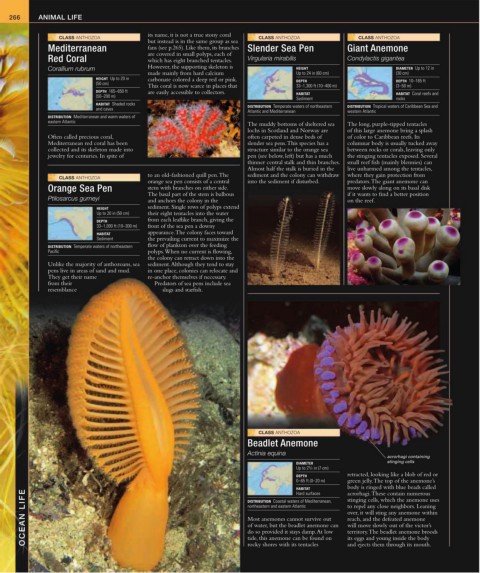
266     ANIMAL LIFE


                  CLASS ANTHOZOA             its name, it is not a true stony coral   CLASS ANTHOZOA        CLASS ANTHOZOA
                                             but instead is in the same group as sea
               Mediterranean                 fans (see p.265). Like them, its branches   Slender Sea Pen   Giant Anemone
                                             are covered in small polyps, each of
               Red Coral                     which has eight branched tentacles.   Virgularia mirabilis   Condylactis gigantea
                                             However, the supporting skeleton is         HEIGHT                        DIAMETER  Up to 12 in
                                             made mainly from hard calcium               Up to 24 in (60 cm)           (30 cm)
               Corallium rubrum
                             HEIGHT  Up to 20 in   carbonate colored a deep red or pink.   DEPTH                       DEPTH  10–165 ft
                              (50 cm)
                                             This coral is now scarce in places that     33–1,300 ft (10–400 m)        (3–50 m)
                             DEPTH  165–650 ft   are easily accessible to collectors.    HABITAT                       HABITAT  Coral reefs and
                              (50–200 m)
                                                                                         Sediment                      rocks
                             HABITAT  Shaded rocks                         DISTRIBUTION  Temperate waters of northeastern   DISTRIBUTION  Tropical waters of Caribbean Sea and
                              and caves
                                                                           Atlantic and Mediterranean   western Atlantic
               DISTRIBUTION  Mediterranean and warm waters of
               eastern Atlantic
                                                                           The muddy bottoms of sheltered sea   The long, purple-tipped tentacles
                                                                           lochs in Scotland and Norway are   of this large anemone bring a splash
               Often called precious coral,                                often carpeted in dense beds of   of color to Caribbean reefs. Its
               Mediterranean red coral has been                            slender sea pens. This species has a   columnar body is usually tucked away
               collected and its skeleton made into                        structure similar to the orange sea    between rocks or corals, leaving only
               jewelry for centuries. In spite of                          pen (see below, left) but has a much   the stinging tentacles exposed. Several
                                                                           thinner central stalk and thin branches.  small reef fish (mainly blennies) can
                                                                           Almost half the stalk is buried in the   live unharmed among the tentacles,
                  CLASS ANTHOZOA             to an old-fashioned quill pen. The   sediment and the colony can withdraw   where they gain protection from
                                             orange sea pen consists of a central   into the sediment if disturbed.   predators. The giant anemone can
               Orange Sea Pen                stem with branches on either side.                         move slowly along on its basal disk
                                             The basal part of the stem is bulbous                      if it wants to find a better position
               Ptilosarcus gurneyi           and anchors the colony in the                              on the reef.
                              HEIGHT         sediment. Single rows of polyps extend
                              Up to 20 in (50 cm)  their eight tentacles into the water
                              DEPTH          from each leaflike branch, giving the
                              33–1,000 ft (10–300 m)  front of the sea pen a downy
                              HABITAT        appearance. The colony faces toward
                              Sediment       the prevailing current to maximize the
               DISTRIBUTION  Temperate waters of northeastern   flow of plankton over the feeding
               Pacific                        polyps. When no current is flowing,
                                             the colony can retract down into the
               Unlike the majority of anthozoans, sea   sediment. Although they tend to stay
               pens live in areas of sand and mud.   in one place, colonies can relocate and
               They get their name           re-anchor themselves if necessary.
               from their                      Predators of sea pens include sea
               resemblance                       slugs and starfish.


                                                                              CLASS ANTHOZOA
                                                                           Beadlet Anemone

                                                                                                                    acrorhagi containing
                                                                           Actinia equina
                                                                                         DIAMETER                   stinging cells
                                                                                             3
                                                                                         Up to 2 / 4 in (7 cm)
                                                                                         DEPTH          retracted, looking like a blob of red or
                                                                                         0–65 ft (0–20 m)  green jelly. The top of the anemone’s
                                                                                         HABITAT        body is ringed with blue beads called
        OCEAN LIFE                                                         Most anemones cannot survive out    to repel any close neighbors. Leaning
                                                                                         Hard surfaces
                                                                                                        acrorhagi. These contain numerous
                                                                                                        stinging cells, which the anemone uses
                                                                           DISTRIBUTION  Coastal waters of Mediterranean,
                                                                           northeastern and eastern Atlantic
                                                                                                        over, it will sting any anemone within
                                                                                                        reach, and the defeated anemone
                                                                                                        will move slowly out of the victor’s
                                                                           of water, but the beadlet anemone can
                                                                                                        territory. The beadlet anemone broods
                                                                           do so provided it stays damp. At low
                                                                                                        its eggs and young inside the body
                                                                           tide, this anemone can be found on
                                                                                                        and ejects them through its mouth.
                                                                           rocky shores with its tentacles

