


Page 276 - (DK) Ocean - The Definitive Visual Guide
P. 276
274 ANIMAL LIFE
Segmented Worms
SEGMENTED WORMS include two
DOMAIN Eucarya
familiar, predominantly land-based
KINGDOM Animalia
and freshwater groups, the earthworms
PHYLUM Annelida and the leeches. In the oceans, a third
CLASSES 2 group, the bristleworms or polychaetes,
SPECIES 15,000 are numerous and diverse. These
include burrowing lugworms, BRISTLEWORM
free-living predatory ragworms, and tube-dwelling worms. All Fire worms have long,
sharp bristles on each body
segmented worms share one main characteristic—the long, soft section. These break off if the worm is
body is divided into a series of almost identical, linked segments. attacked and can cause severe skin irritation.
Anatomy Reproduction
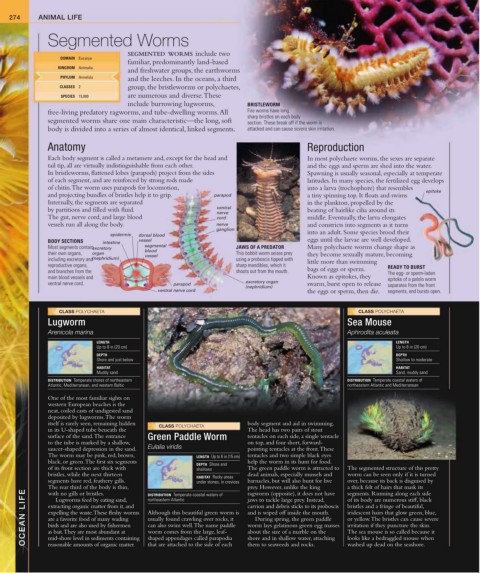
Each body segment is called a metamere and, except for the head and In most polychaete worms, the sexes are separate
tail tip, all are virtually indistinguishable from each other. and the eggs and sperm are shed into the water.
In bristleworms, flattened lobes (parapods) project from the sides Spawning is usually seasonal, especially at temperate
of each segment, and are reinforced by strong rods made latitudes. In many species, the fertilized egg develops
of chitin. The worm uses parapods for locomotion, into a larva (trochophore) that resembles
epitoke
and projecting bundles of bristles help it to grip. parapod a tiny spinning top. It floats and swims
Internally, the segments are separated in the plankton, propelled by the
by partitions and filled with fluid. ventral beating of hairlike cilia around its
nerve
The gut, nerve cord, and large blood cord middle. Eventually, the larva elongates
vessels run all along the body. nerve and constricts into segments as it turns
ganglion
epidermis dorsal blood into an adult. Some species brood their
BODY SECTIONS intestine vessel eggs until the larvae are well developed.
segmental
Most segments contain excretory JAWS OF A PREDATOR Many polychaete worms change shape as
blood
their own organs, organ vessel This bobbit worm seizes prey they become sexually mature, becoming
including excretory and (nephridium) using a proboscis tipped with little more than swimming
reproductive organs, sharp mandibles, which it READY TO BURST
and branches from the shoots out from the mouth. bags of eggs or sperm. The egg- or sperm-laden
main blood vessels and Known as epitokes, they epitoke of a palolo worm
ventral nerve cord. parapod excretory organ swarm, burst open to release separates from the front
(nephridium)
ventral nerve cord the eggs or sperm, then die. segments, and bursts open.
CLASS POLYCHAETA CLASS POLYCHAETA
Lugworm Sea Mouse
Arenicola marina Aphrodita aculeata
LENGTH LENGTH
Up to 8 in (20 cm) Up to 8 in (20 cm)
DEPTH DEPTH
Shore and just below Shallow to moderate
HABITAT HABITAT
Muddy sand Sand, muddy sand
DISTRIBUTION Temperate shores of northeastern DISTRIBUTION Temperate coastal waters of
Atlantic, Mediterranean, and western Baltic northeastern Atlantic and Mediterranean
One of the most familiar sights on
western European beaches is the
neat, coiled casts of undigested sand
deposited by lugworms. The worm
itself is rarely seen, remaining hidden CLASS POLYCHAETA body segment and aid in swimming.
in its U-shaped tube beneath the The head has two pairs of stout
surface of the sand. The entrance Green Paddle Worm tentacles on each side, a single tentacle
to the tube is marked by a shallow, on top, and four short, forward-
saucer-shaped depression in the sand. Eulalia viridis pointing tentacles at the front. These
The worm may be pink, red, brown, LENGTH Up to 6 in (15 cm) tentacles and two simple black eyes
black, or green. The first six segments help the worm in its hunt for food.
DEPTH Shore and
of its front section are thick with shallows The green paddle worm is attracted to The segmented structure of this pretty
bristles, while the next thirteen dead animals, especially mussels and worm can be seen only if it is turned
HABITAT Rocky areas
segments have red, feathery gills. under stones, in crevices barnacles, but will also hunt for live over, because its back is disguised by
The rear third of the body is thin, DISTRIBUTION Temperate coastal waters of prey. However, unlike the king a thick felt of hairs that mask its
OCEAN LIFE extracting organic matter from it, and Although this beautiful green worm is carrion and debris sticks to its proboscis bristles and a fringe of beautiful,
segments. Running along each side
ragworm (opposite), it does not have
with no gills or bristles.
Lugworms feed by eating sand,
jaws to tackle large prey. Instead,
of its body are numerous stiff, black
northeastern Atlantic
expelling the waste. These fleshy worms
and is wiped off inside the mouth.
iridescent hairs that glow green, blue,
or yellow. The bristles can cause severe
are a favorite food of many wading
usually found crawling over rocks, it
During spring, the green paddle
worm lays gelatinous green egg masses
can also swim well. The name paddle
irritation if they puncture the skin.
birds and are also used by fishermen
The sea mouse is so called because it
as bait. They are most abundant at
worm comes from the large, leaf-
about the size of a marble on the
looks like a bedraggled mouse when
mid-shore level in sediments containing
shore and in shallow water, attaching
shaped appendages called parapodia
washed up dead on the seashore.
reasonable amounts of organic matter.
that are attached to the side of each
them to seaweeds and rocks.

