


Page 272 - (DK) Ocean - The Definitive Visual Guide
P. 272
270     ANIMAL LIFE


                  CLASS ANTHOZOA
               White Zoanthid

               Parazoanthus anguicomus
                              HEIGHT  1 in (2.5 cm)
                              DEPTH  65–1,300 ft
                              (20–400 m)
                              HABITAT  Shaded rocks,
                              wrecks, and shells
               DISTRIBUTION  Temperate waters of northeastern
               Atlantic

               Most zoanthids are found in tropical
               waters, but the white zoanthid is
               common in the north Atlantic. Its
               white polyps arise from an encrusting
               base and it has two circles of tentacles
               around the mouth. One circle is usually
               held upward while the other lies flat.
               As well as covering rocks and wrecks,
               this species also encrusts worm tubes
               and Lophelia reefs (see p.179).


                  CLASS ANTHOZOA                                              CLASS ANTHOZOA            branches. Made of a tough, horny
                                                                                                        material, the skeleton is valuable
               Whip Coral                                                  Bushy Black Coral            as it can be cut and polished to make
               Cirrhipathes species                                        Plumapathes pennacea         jewelry, although this species is not
                                                                                                        widely used for this purpose.
                              LENGTH                                                     HEIGHT
                              Up to 3  ft (1 m)                                          Up to 5 ft (1.5 m)
                              DEPTH                                                      DEPTH
                              10–165 ft (3–50 m)                                         15–1,100 ft (5–330 m)
                              HABITAT                                                    HABITAT
                              Coral reefs    or coiled as in the species belonging       Coral reefs
               DISTRIBUTION  Tropical waters of eastern Indian   to the genus Cirripathes shown here   DISTRIBUTION  Tropical waters of Gulf of Mexico,
               Ocean and western Pacific      (whip corals are difficult to identify   Caribbean Sea, and western Atlantic
                                             and many species remain undescribed).
               Whip corals, or wire corals, belong    The feeding polyps of whip corals and   Bushy black coral grows as a plantlike
               to a group of anthozoans called   black corals can be seen easily because,   colony with branches shaped like large
               antipatharians to which the black   unlike sea fans, they cannot retract   bird feathers. There are many different
               corals (see right) also belong. Whip   their short, pointed tentacles. Gobies   species of black corals, and they get
               coral grows as a single unbranched   live among the tentacles, hanging onto   their name from the strong black
               colony that can be either straight    the coral with suckerlike pelvic fins.   skeleton that strengthens their


                                                                                                            CLASS ANTHOZOA
                                                                                                        Tube Anemone

                                                                                                        Cerianthus membranaceus
                                                                                                                       HEIGHT
                                                                                                                       14 in (35 cm)
                                                                                                                       DEPTH
                                                                                                                       33–330 ft (10–100 m)
                                                                                                                       HABITAT
                                                                                                                       Muddy sand
                                                                                                        DISTRIBUTION  Mediterranean and northeast Atlantic
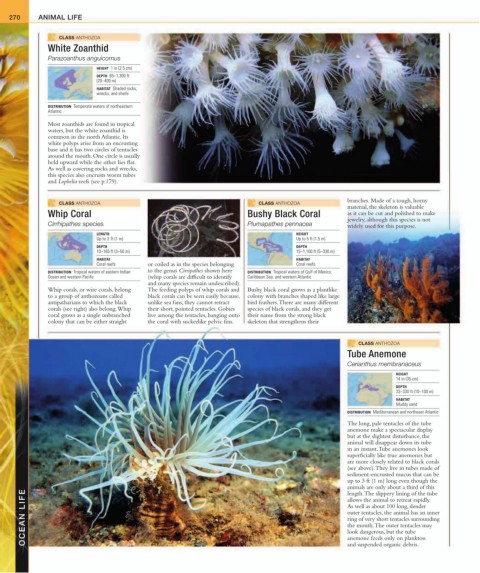
                                                                                                        The long, pale tentacles of the tube
                                                                                                        anemone make a spectacular display
                                                                                                        but at the slightest disturbance, the
                                                                                                        animal will disappear down its tube
                                                                                                        in an instant. Tube anemones look
                                                                                                        superficially like true anemones but
                                                                                                        are more closely related to black corals
                                                                                                        (see above). They live in tubes made of
                                                                                                        sediment-encrusted mucus that can be
                                                                                                        up to 3 ft (1 m) long even though the
                                                                                                        animals are only about a third of this
        OCEAN LIFE                                                                                      As well as about 100 long, slender
                                                                                                        length. The slippery lining of the tube
                                                                                                        allows the animal to retreat rapidly.
                                                                                                        outer tentacles, the animal has an inner
                                                                                                        ring of very short tentacles surrounding
                                                                                                        the mouth. The outer tentacles may
                                                                                                        look dangerous, but the tube
                                                                                                        anemone feeds only on plankton
                                                                                                        and suspended organic debris.

