Page 277 - (DK) Ocean - The Definitive Visual Guide
P. 277
SEGMENTED WORMS            275


                CLASS POLYCHAETA
                                                                                                        WORM REEFS
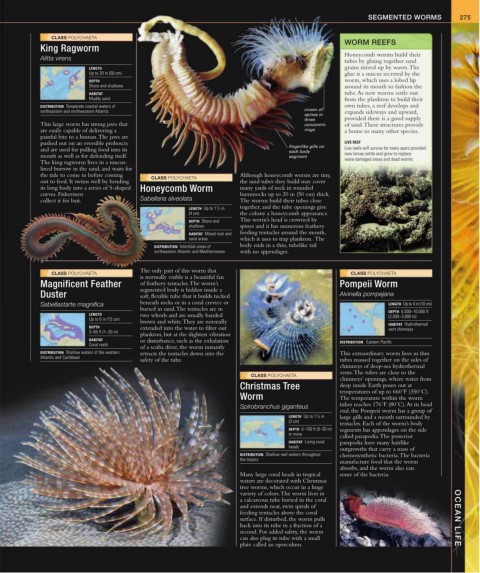
             King Ragworm
                                                                                                        Honeycomb worms build their
                                                                                                        tubes by gluing together sand
             Alitta virens
                           LENGTH                                                                       grains stirred up by waves. The
                           Up to 20 in (50 cm)                                                          glue is a mucus secreted by the
                           DEPTH                                                                        worm, which uses a lobed lip
                           Shore and shallows                                                           around its mouth to fashion the
                           HABITAT                                                                      tube. As new worms settle out
                           Muddy sand                                                                   from the plankton to build their
             DISTRIBUTION  Temperate coastal waters of                                                  own tubes, a reef develops and
             northeastern and northwestern Atlantic                                         crown of    expands sideways and upward,
                                                                                            spines in
                                                                                            three       provided there is a good supply
             This large worm has strong jaws that                                           concentric   of sand. These structures provide
             are easily capable of delivering a                                             rings       a home to many other species.
             painful bite to a human. The jaws are
             pushed out on an eversible proboscis                                                       LIVE REEF
                                                                                       fingerlike gills on   Live reefs will survive for many years provided
             and are used for pulling food into its                                    each body
             mouth as well as for defending itself.                                    segment          new larvae settle and grow to replace
                                                                                                        wave-damaged areas and dead worms.
             The king ragworm lives in a mucus-
             lined burrow in the sand, and waits for
             the tide to come in before coming   CLASS POLYCHAETA       Although honeycomb worms are tiny,
             out to feed. It swims well by bending                      the sand tubes they build may cover
             its long body into a series of S-shaped   Honeycomb Worm   many yards of rock in rounded
             curves. Fishermen                                          hummocks up to 20 in (50 cm) thick.
             collect it for bait.          Sabellaria alveolata         The worms build their tubes close
                                                         LENGTH  Up to 1 / 2 in   together, and the tube openings give
                                                                 1
                                                         (4 cm)         the colony a honeycomb appearance.
                                                         DEPTH  Shore and   This worm’s head is crowned by
                                                         shallows       spines and it has numerous feathery
                                                         HABITAT  Mixed rock and   feeding tentacles around the mouth,
                                                         sand areas     which it uses to trap plankton.  The
                                               DISTRIBUTION  Intertidal areas of   body ends in a thin, tubelike tail
                                               northeastern Atlantic and Mediterranean  with no appendages.

                                           The only part of this worm that
                CLASS POLYCHAETA                                                                         CLASS POLYCHAETA
                                           is normally visible is a beautiful fan
             Magnificent Feather           of feathery tentacles. The worm’s                          Pompeii Worm
             Duster                        segmented body is hidden inside a                          Alvinella pompejana
                                           soft, flexible tube that it builds tucked
                                           beneath rocks or in a coral crevice or                                    LENGTH  Up to 4 in (10 cm)
             Sabellastarte magnifica
                                           buried in sand. The tentacles are in                                      DEPTH  6,500–10,000 ft
                           LENGTH          two whorls and are usually banded                                         (2,000–3,000 m)
                           Up to 6 in (15 cm)
                                           brown and white. They are normally                                        HABITAT  Hydrothermal
                           DEPTH           extended into the water to filter out                                     vent chimneys
                           3–65 ft (1–20 m)
                                           plankton, but at the slightest vibration
                           HABITAT         or disturbance, such as the exhalation                     DISTRIBUTION   Eastern Pacific
                           Coral reefs
                                           of a scuba diver, the worm instantly
             DISTRIBUTION  Shallow waters of the western   retracts the tentacles down into the       This extraordinary worm lives in thin
             Atlantic and Caribbean
                                           safety of the tube.                                        tubes massed together on the sides of
                                                                                                      chimneys of deep-sea hydrothermal
                                                                                                      vents. The tubes are close to the
                                                                            CLASS POLYCHAETA
                                                                                                      chimneys’ openings, where water from
                                                                        Christmas Tree                deep inside Earth pours out at
                                                                                                      temperatures of up to 660˚F (350˚C).
                                                                        Worm                          The temperature within the worm
                                                                                                      tubes reaches 176˚F (80˚C). At its head
                                                                                                      end, the Pompeii worm has a group of
                                                                        Spirobranchus giganteus
                                                                                       LENGTH  Up to 1 / 4 in   large gills and a mouth surrounded by
                                                                                               1
                                                                                       (3 cm)         tentacles. Each of the worm’s body
                                                                                       DEPTH  0–100 ft (0–30 m)   segments has appendages on the side
                                                                                       or more        called parapodia. The posterior
                                                                                       HABITAT  Living coral   parapodia have many hairlike
                                                                                       heads          outgrowths that carry a mass of
                                                                        DISTRIBUTION  Shallow reef waters throughout    chemosynthetic bacteria. The bacteria
                                                                        the tropics                   manufacture food that the worm
                                                                                                      absorbs, and the worm also eats
                                                                        Many large coral heads in tropical   some of the bacteria.
                                                                        waters are decorated with Christmas
                                                                        tree worms, which occur in a huge
                                                                        variety of colors. The worm lives in
                                                                        a calcareous tube buried in the coral
                                                                        and extends neat, twin spirals of
                                                                        feeding tentacles above the coral
                                                                        surface. If disturbed, the worm pulls                            OCEAN LIFE
                                                                        back into its tube in a fraction of a
                                                                        second. For added safety, the worm
                                                                        can also plug its tube with a small
                                                                        plate called an operculum.
   272   273   274   275   276   277   278   279   280   281   282