


Page 278 - (DK) Ocean - The Definitive Visual Guide
P. 278
276     ANIMAL LIFE


               Mollusks


                                       AMONG THE MOST SUCCESSFUL of all marine animals,
                   DOMAIN  Eucarya
                                       mollusks display great diversity and a remarkable range
                  KINGDOM  Animalia
                                       of body forms, allowing them to live almost everywhere
                   PHYLUM  Mollusca
                                       from the ocean depths to the splash zone. They include
                   CLASSES  8
                                       oysters, sea slugs, and octopuses. Most species have shells
                   SPECIES  73,682
                                       and are passive or slow-moving; some lack eyes. Others
               are intelligent, active hunters with complex nervous systems and large eyes.
               Filter-feeding mollusks, such as clams, are crucial to coastal ecosystems,
               as they provide food for other animals and improve water quality and clarity.
               Many mollusks are commercially important for food, pearls, and their shells.

               Anatomy
               Most mollusks have a head, a soft body mass, and a muscular foot.
               The foot is formed from the lower body surface and helps it to
               move. Mollusks have what is called a hydrostatic skeleton—their
               bodies are supported by internal fluid pressure rather than a hard
               skeleton. All mollusks have a mantle, a body layer that covers the
               upper body and may or may not secrete a shell. The shell of
               bivalves (clams and relatives) has two halves joined by a hinge;
               these can be held closed by powerful muscles while the tide is out,
               or if danger threatens. Mollusks other than bivalves have a rasping
               mouthpart, or radula, which is unique to mollusks. Cephalopods
               (octopuses, squid, and cuttlefish) also have beaklike jaws as well    REEF-DWELLING GOLIATH
                                                                      The tropical giant clam is the
               as tentacles, but most lack a shell, while most gastropods (slugs
                                                                      largest bivalve and may measure
               and snails) have a single shell. This is usually a spiral in snails,    more than 3 ft (1 m) across and
               but can be cone-shaped in other forms, such as limpets.   weigh over 440 lb (220 kg).
                                 gill
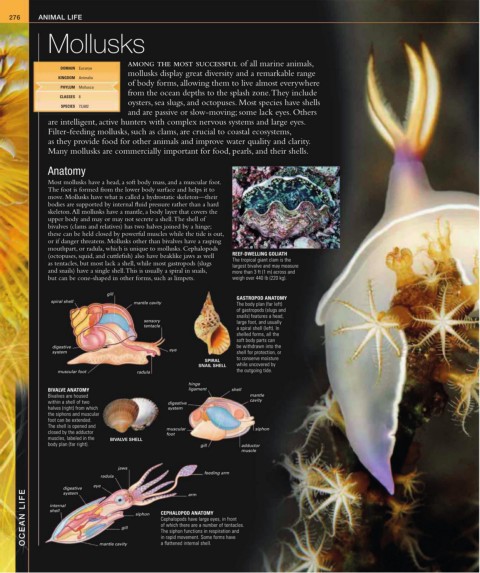
                                                                       GASTROPOD ANATOMY
                spiral shell             mantle cavity                 The body plan (far left)
                                                                       of gastropods (slugs and
                                                                       snails) features a head,
                                            sensory                    large foot, and usually
                                            tentacle
                                                                       a spiral shell (left). In
                                                                       shelled forms, all the
                                                                       soft body parts can
                digestive                                              be withdrawn into the
                system                             eye                 shell for protection, or
                                                                       to conserve moisture
                                                              SPIRAL
                                                                       while uncovered by
                                                            SNAIL SHELL
                  muscular foot           radula                       the outgoing tide.
                                                         hinge
               BIVALVE ANATOMY                           ligament     shell
               Bivalves are housed                                         mantle
               within a shell of two               digestive               cavity
               halves (right) from which           system
               the siphons and muscular
               foot can be extended.
               The shell is opened and
                                                  muscular                   siphon
               closed by the adductor
                                                  foot
               muscles, labeled in the
                                  BIVALVE SHELL
               body plan (far right).                        gill        adductor
                                                                         muscle
                                    jaws
                                                              feeding arm
                               radula
                             eye
                    digestive                            arm
        OCEAN LIFE  internal   mantle cavity  siphon  CEPHALOPOD ANATOMY
                    system
                shell
                                                 Cephalopods have large eyes, in front
                                                 of which there are a number of tentacles.
                                     gill
                                                 The siphon functions in respiration and
                                                 in rapid movement. Some forms have
                                                 a flattened internal shell.

