


Page 279 - (DK) Ocean - The Definitive Visual Guide
P. 279
MOLLUSKS         277


             Sense Organs                                                 HUMAN IMPACT

             Touch, smell, taste, and vision are well developed in many mollusks.    GRAFTING OYSTERS
             The nervous system has several paired bundles of nervous tissue
             (ganglia), some of which operate the foot, and interpret sensory   Pearls form in oysters when a grain
             information such as light intensity. Photoreceptors range from the   of sand or other irritant lodges in
                                                                          their shells. The oyster coats the
             simple eyes (ocelli) seen along the edges of the mantle or on bivalve   grain with a substance called nacre,
             siphons, to the sophisticated image-forming eyes of cephalopods.   forming a pearl. Today many pearls
             Cephalopods are also capable of rapidly changing their color.  are cultured artificially: the shell is
                                                                          opened just enough to introduce
              PIGMENTED SKIN CELLS HELP CUTTLEFISH TO CHANGE COLOR        an irritant into the mantle cavity.
                                                                          SEEDING AN OYSTER
                                                                          The best-shaped artificial pearls are produced by
                                                                          “seeding” oysters with a tiny pearl bead and a
                                                                          piece of mantle tissue from another mollusk .


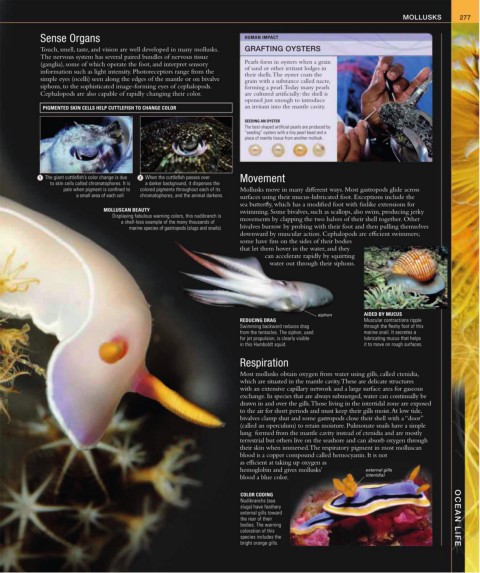
            1  The giant cuttlefish’s color change is due   2  When the cuttlefish passes over    Movement
                to skin cells called chromatophores. It is   a darker background, it disperses the
                    pale when pigment is confined to   colored pigments throughout each of its   Mollusks move in many different ways. Most gastropods glide across
                        a small area of each cell.  chromatophores, and the animal darkens.  surfaces using their mucus-lubricated foot. Exceptions include the
                                                                        sea butterfly, which has a modified foot with finlike extensions for
                                MOLLUSCAN BEAUTY                        swimming. Some bivalves, such as scallops, also swim, producing jerky
                                  Displaying fabulous warning colors, this nudibranch is
                                     a shell-less example of the many thousands of   movements by clapping the two halves of their shell together. Other
                                       marine species of gastropods (slugs and snails).   bivalves burrow by probing with their foot and then pulling themselves
                                                                        downward by muscular action. Cephalopods are efficient swimmers;
                                                                        some have fins on the sides of their bodies
                                                                        that let them hover in the water, and they
                                                                                can accelerate rapidly by squirting
                                                                                 water out through their siphons.


                                                                                                siphon       AIDED BY MUCUS
                                                                        REDUCING DRAG                        Muscular contractions ripple
                                                                        Swimming backward reduces drag       through the fleshy foot of this
                                                                        from the tentacles. The siphon, used   marine snail. It secretes a
                                                                        for jet propulsion, is clearly visible    lubricating mucus that helps
                                                                        in this Humboldt squid.              it to move on rough surfaces.

                                                                        Respiration
                                                                        Most mollusks obtain oxygen from water using gills, called ctenidia,
                                                                        which are situated in the mantle cavity. These are delicate structures
                                                                        with an extensive capillary network and a large surface area for gaseous
                                                                        exchange. In species that are always submerged, water can continually be
                                                                        drawn in and over the gills. Those living in the intertidal zone are exposed
                                                                        to the air for short periods and must keep their gills moist. At low tide,
                                                                        bivalves clamp shut and some gastropods close their shell with a “door”
                                                                        (called an operculum) to retain moisture. Pulmonate snails have a simple
                                                                        lung  formed from the mantle cavity instead of ctenidia and are mostly
                                                                        terrestrial but others live on the seashore and can absorb oxygen through
                                                                        their skin when immersed.The respiratory pigment in most molluscan
                                                                        blood is a copper compound called hemocyanin. It is not
                                                                        as efficient at taking up oxygen as
                                                                        hemoglobin and gives mollusks’        external gills
                                                                        blood a blue color.                   (ctenidia)


                                                                         COLOR CODING
                                                                         Nudibranchs (sea
                                                                         slugs) have feathery
                                                                         external gills toward
                                                                         the rear of their                                               OCEAN LIFE
                                                                         bodies. The warning
                                                                         coloration of this
                                                                         species includes the
                                                                         bright orange gills.

