Page 275 - (DK) Ocean - The Definitive Visual Guide
P. 275
RIBBON WORMS          273


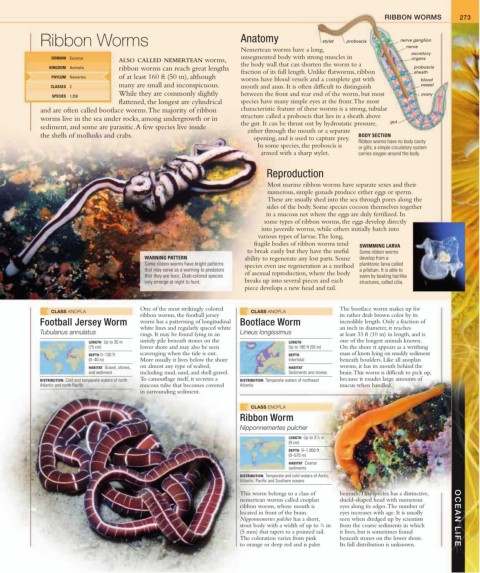
             Ribbon Worms                                                Anatomy                 stylet  proboscis      nerve ganglion

                                                                         Nemertean worms have a long,                     nerve
                                                                                                                           excretory
                DOMAIN  Eucarya                                          unsegmented body with strong muscles in           organs
                                    ALSO CALLED NEMERTEAN worms,
                                                                         the body wall that can shorten the worm to a
                KINGDOM Animalia    ribbon worms can reach great lengths                                                    proboscis
                                                                         fraction of its full length. Unlike flatworms, ribbon   sheath
                PHYLUM Nemertea     of at least 160 ft (50 m), although   worms have blood vessels and a complete gut with    blood
                                    many are small and inconspicuous.                                                         vessel
                CLASSES 2                                                mouth and anus. It is often difficult to distinguish
                                    While they are commonly slightly     between the front and rear end of the worm, but most   ovary
                SPECIES 1,358
                                    flattened, the longest are cylindrical   species have many simple eyes at the front. The most
             and are often called bootlace worms. The majority of ribbon   characteristic feature of these worms is a strong, tubular
             worms live in the sea under rocks, among undergrowth or in   structure called a proboscis that lies in a sheath above
                                                                         the gut. It can be thrust out by hydrostatic pressure,   gut
             sediment, and some are parasitic. A few species live inside
                                                                           either through the mouth or a separate
             the shells of mollusks and crabs.                                                              BODY SECTION
                                                                            opening, and is used to capture prey.
                                                                                                            Ribbon worms have no body cavity
                                                                              In some species, the proboscis is   or gills; a simple circulatory system
                                                                               armed with a sharp stylet.   carries oxygen around the body.
                                                                                Reproduction
                                                                                 Most marine ribbon worms have separate sexes and their
                                                                                 numerous, simple gonads produce either eggs or sperm.
                                                                                 These are usually shed into the sea through pores along the
                                                                                sides of the body. Some species cocoon themselves together
                                                                                in a mucous net where the eggs are duly fertilized. In
                                                                                some types of ribbon worms, the eggs develop directly
                                                                               into juvenile worms, while others initially hatch into
                                                                              various types of larvae. The long,
                                                                             fragile bodies of ribbon worms tend   SWIMMING LARVA
                                                                           to break easily but they have the useful   Some ribbon worms
                                            WARNING PATTERN               ability to regenerate any lost parts. Some   develop from a
                                            Some ribbon worms have bright patterns   species even use regeneration as a method   planktonic larva called
                                            that may serve as a warning to predators                        a pilidium. It is able to
                                            that they are toxic. Drab-colored species   of asexual reproduction, where the body   swim by beating hairlike
                                            only emerge at night to hunt.  breaks up into several pieces and each   structures, called cilia.
                                                                          piece develops a new head and tail.


                                           One of the most strikingly colored                         The bootlace worm makes up for
                CLASS ANOPLA                                                CLASS ANOPLA
                                           ribbon worms, the football jersey                          its rather drab brown color by its
             Football Jersey Worm          worm has a patterning of longitudinal   Bootlace Worm      incredible length. Only a fraction of
                                           white lines and regularly spaced white                     an inch in diameter, it reaches
                                           rings. It may be found lying in an                         at least 33 ft (10 m) in length, and is
             Tubulanus annulatus                                        Lineus longissimus
                           LENGTH  Up to 30 in   untidy pile beneath stones on the     LENGTH         one of the longest animals known.
                           (75 cm)         lower shore and may also be seen            Up to 180 ft (55 m)  On the shore it appears as a writhing
                           DEPTH 0–130 ft   scavenging when the tide is out.           DEPTH          mass of knots lying on muddy sediment
                           (0–40 m)        More usually it lives below the shore       Intertidal     beneath boulders. Like all anoplan
                           HABITAT  Gravel, stones,   on almost any type of seabed,    HABITAT        worms, it has its mouth behind the
                           and sediment    including mud, sand, and shell gravel.      Sediments and stones  brain. This worm is difficult to pick up,
             DISTRIBUTION  Cold and temperate waters of north   To camouflage itself, it secretes a   DISTRIBUTION  Temperate waters of northeast   because it exudes large amounts of
             Atlantic and north Pacific     mucous tube that becomes covered    Atlantic               mucus when handled.
                                           in surrounding sediment.

                                                                            CLASS ENOPLA
                                                                        Ribbon Worm

                                                                        Nipponnemertes pulcher
                                                                                       LENGTH  Up to 3 / 2 in
                                                                                               1
                                                                                       (9 cm)
                                                                                       DEPTH  0–1,900 ft
                                                                                       (0–570 m)
                                                                                       HABITAT  Coarse
                                                                                       sediments
                                                                        DISTRIBUTION  Temperate and cold waters of Arctic,
                                                                        Atlantic, Pacific and Southern oceans

                                                                        This worm belongs to a class of   beneath. This species has a distinctive,
                                                                        nemertean worms called enoplan   shield-shaped head with numerous
                                                                        ribbon worms, whose mouth is   eyes along its edges. The number of
                                                                        located in front of the brain.   eyes increases with age. It is usually
                                                                        Nipponnemertes pulcher has a short,   seen when dredged up by scientists   OCEAN LIFE
                                                                        stout body with a width of up to /4 in   from the coarse sediments in which
                                                                                                1
                                                                        (5 mm) that tapers to a pointed tail.   it lives, but is sometimes found
                                                                        The coloration varies from pink    beneath stones on the lower shore.
                                                                        to orange or deep red and is paler   Its full distribution is unknown.
   270   271   272   273   274   275   276   277   278   279   280