


Page 274 - (DK) Ocean - The Definitive Visual Guide
P. 274
272 ANIMAL LIFE
CLASS RHABDITOPHORA CLASS RHABDITOPHORA
Exquisite Lined Divided Flatworm
Flatworm Pseudoceros dimidiatus
LENGTH
Pseudobiceros bedfordi
Up to 3 in (8 cm)
LENGTH DEPTH
Up to 3 in (8 cm)
Not recorded
DEPTH HABITAT
Not recorded
Coral reefs
HABITAT
Coral reefs DISTRIBUTION Tropical waters of Indian and western
Pacific oceans
DISTRIBUTION Tropical waters of Indian and western
Pacific oceans
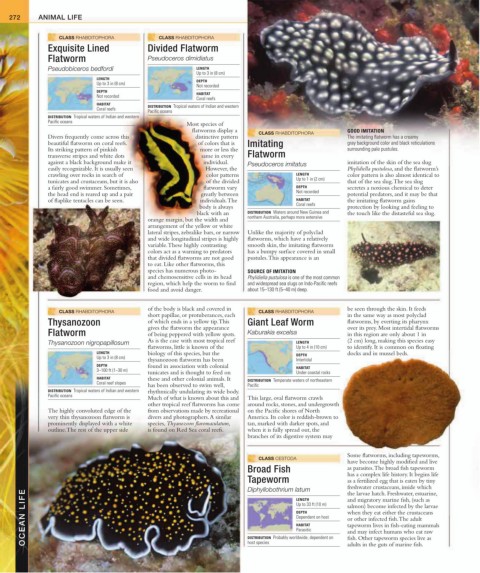
Most species of
flatworms display a CLASS RHABDITOPHORA GOOD IMITATION
Divers frequently come across this distinctive pattern The imitating flatworm has a creamy
beautiful flatworm on coral reefs. of colors that is Imitating gray background color and black reticulations
Its striking pattern of pinkish more or less the surrounding pale pustules.
transverse stripes and white dots same in every Flatworm
against a black background make it individual. imitation of the skin of the sea slug
easily recognizable. It is usually seen However, the Pseudoceros imitatus Phylidiella pustulosa, and the flatworm’s
crawling over rocks in search of color patterns LENGTH color pattern is also almost identical to
tunicates and crustaceans, but it is also of the divided Up to 1 in (2 cm) that of the sea slug. The sea slug
a fairly good swimmer. Sometimes, flatworm vary DEPTH secretes a noxious chemical to deter
the head end is reared up and a pair greatly between Not recorded potential predators, and it may be that
of flaplike tentacles can be seen. individuals. The HABITAT the imitating flatworm gains
body is always Coral reefs protection by looking and feeling to
black with an DISTRIBUTION Waters around New Guinea and the touch like the distasteful sea slug.
orange margin, but the width and northern Australia, perhaps more extensive
arrangement of the yellow or white
lateral stripes, zebralike bars, or narrow Unlike the majority of polyclad
and wide longitudinal stripes is highly flatworms, which have a relatively
variable. These highly contrasting smooth skin, the imitating flatworm
colors act as a warning to predators has a bumpy surface covered in small
that divided flatworms are not good pustules. This appearance is an
to eat. Like other flatworms, this
species has numerous photo- SOURCE OF IMITATION
and chemosensitive cells in its head Phylidiella pustulosa is one of the most common
region, which help the worm to find and widespread sea slugs on Indo-Pacific reefs
food and avoid danger. about 15–130 ft (5–40 m) deep.
of the body is black and covered in be seen through the skin. It feeds
CLASS RHABDITOPHORA CLASS RHABDITOPHORA
short papillae, or protuberances, each in the same way as most polyclad
Thysanozoon of which ends in a yellow tip. This Giant Leaf Worm flatworms, by everting its pharynx
gives the flatworm the appearance over its prey. Most intertidal flatworms
Flatworm of being peppered with yellow spots. Kaburakia excelsa in this region are only about 1 in
As is the case with most tropical reef LENGTH (2 cm) long, making this species easy
Thysanozoon nigropapillosum
flatworms, little is known of the Up to 4 in (10 cm) to identify. It is common on floating
LENGTH biology of this species, but the docks and in mussel beds.
Up to 3 in (8 cm) thysanozoon flatworm has been DEPTH
Intertidal
DEPTH found in association with colonial
3–100 ft (1–30 m) tunicates and is thought to feed on HABITAT
Under coastal rocks
HABITAT these and other colonial animals. It
Coral reef slopes has been observed to swim well, DISTRIBUTION Temperate waters of northeastern
Pacific
DISTRIBUTION Tropical waters of Indian and western rhythmically undulating its wide body.
Pacific oceans Much of what is known about this and This large, oval flatworm crawls
other tropical reef flatworms has come around rocks, stones, and undergrowth
The highly convoluted edge of the from observations made by recreational on the Pacific shores of North
very thin thysanozoon flatworm is divers and photographers. A similar America. Its color is reddish-brown to
prominently displayed with a white species, Thyanozoon flavomaculatum, tan, marked with darker spots, and
outline. The rest of the upper side is found on Red Sea coral reefs. when it is fully spread out, the
branches of its digestive system may
Some flatworms, including tapeworms,
CLASS CESTODA
have become highly modified and live
Broad Fish as parasites. The broad fish tapeworm
has a complex life history. It begins life
Tapeworm as a fertilized egg that is eaten by tiny
freshwater crustaceans, inside which
OCEAN LIFE DISTRIBUTION Probably worldwide, dependent on salmon) become infected by the larvae
the larvae hatch. Freshwater, estuarine,
Diphyllobothrium latum
and migratory marine fish, (such as
LENGTH
Up to 33 ft (10 m)
when they eat either the crustaceans
DEPTH
Dependent on host
or other infected fish. The adult
tapeworm lives in fish-eating mammals
HABITAT
Parasitic
and may infect humans who eat raw
fish. Other tapeworm species live as
host species
adults in the guts of marine fish.

