


Page 271 - (DK) Ocean - The Definitive Visual Guide
P. 271
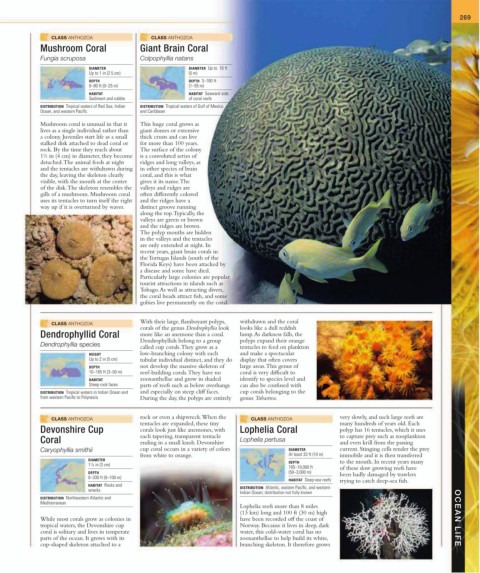
269


                CLASS ANTHOZOA                CLASS ANTHOZOA
             Mushroom Coral                Giant Brain Coral

             Fungia scruposa               Colpophyllia natans
                           DIAMETER                      DIAMETER  Up to  16 ft
                           Up to 1 in (2.5 cm)           (5 m)
                           DEPTH                         DEPTH  3–180 ft
                           0–80 ft (0–25 m)              (1–55 m)
                           HABITAT                       HABITAT  Seaward side
                           Sediment and rubble           of coral reefs
             DISTRIBUTION  Tropical waters of Red Sea, Indian   DISTRIBUTION  Tropical waters of Gulf of Mexico
             Ocean, and western Pacific     and Caribbean

             Mushroom coral is unusual in that it   This huge coral grows as
             lives as a single individual rather than   giant domes or extensive
             a colony. Juveniles start life as a small   thick crusts and can live
             stalked disk attached to dead coral or   for more than 100 years.
             rock. By the time they reach about    The surface of the colony
             1/2 in (4 cm) in diameter, they become   is a convoluted series of
              1
             detached. The animal feeds at night   ridges and long valleys, as
             and the tentacles are withdrawn during   in other species of brain
             the day, leaving the skeleton clearly   coral, and this is what
             visible, with the mouth at the center   gives it its name. The
             of the disk. The skeleton resembles the   valleys and ridges are
             gills of a mushroom. Mushroom coral   often differently colored
             uses its tentacles to turn itself the right   and the ridges have a
             way up if it is overturned by waves.   distinct groove running
                                           along the top. Typically, the
                                           valleys are green or brown
                                           and the ridges are brown.
                                           The polyp mouths are hidden
                                           in the valleys and the tentacles
                                           are only extended at night. In
                                           recent years, giant brain corals in
                                           the Tortugas Islands (south of the
                                           Florida Keys) have been attacked by
                                           a disease and some have died.
                                           Particularly large colonies are popular
                                           tourist attractions in islands such as
                                           Tobago. As well as attracting divers,
                                           the coral heads attract fish, and some
                                           gobies live permanently on the coral.


                CLASS ANTHOZOA             With their large, flamboyant polyps,   withdrawn and the coral
                                           corals of the genus Dendrophyllia look   looks like a dull reddish
             Dendrophyllid Coral           more like an anemone than a coral.   lump. As darkness falls, the
             Dendrophyllia species         Dendrophyllids belong to a group   polyps expand their orange
                                                                        tentacles to feed on plankton
                                           called cup corals. They grow as a
                           HEIGHT          low-branching colony with each   and make a spectacular
                           Up to 2 in (5 cm)  tubular individual distinct, and they do   display that often covers
                           DEPTH           not develop the massive skeleton of   large areas. This genus of
                           10–165 ft (3–50 m)  reef-building corals. They have no   coral is very difficult to
                           HABITAT         zooxanthellae and grow in shaded   identify to species level and
                           Steep rock faces  parts of reefs such as below overhangs   can also be confused with
             DISTRIBUTION  Tropical waters in Indian Ocean and   and especially on steep cliff faces.   cup corals belonging to the
             from western Pacific to Polynesia  During the day, the polyps are entirely   genus Tubastrea.


                CLASS ANTHOZOA             rock or even a shipwreck. When the   CLASS ANTHOZOA        very slowly, and such large reefs are
                                           tentacles are expanded, these tiny                         many hundreds of years old. Each
             Devonshire Cup                corals look just like anemones, with   Lophelia Coral      polyp has 16 tentacles, which it uses
                                           each tapering, transparent tentacle                        to capture prey such as zooplankton
             Coral                         ending in a small knob. Devonshire   Lophelia pertusa      and even krill from the passing
                                           cup coral occurs in a variety of colors     DIAMETER       current. Stinging cells render the prey
             Caryophyllia smithii
                                           from white to orange.                       At least 33 ft (10 m)  immobile and it is then transferred
                           DIAMETER                                                    DEPTH          to the mouth. In recent years many
                            1
                           1 / 4 in (3 cm)
                                                                                       165–10,000 ft   of these slow growing reefs have
                           DEPTH                                                       (50–3,000 m)   been badly damaged by trawlers
                           0–330 ft (0–100 m)
                                                                                       HABITAT  Deep-sea reefs  trying to catch deep-sea fish.
                           HABITAT  Rocks and                           DISTRIBUTION  Atlantic, eastern Pacific, and western
                           wrecks
                                                                        Indian Ocean; distribution not fully known
             DISTRIBUTION  Northeastern Atlantic and
             Mediterranean
                                                                        Lophelia reefs more than 8 miles
                                                                        (13 km) long and 100 ft (30 m) high
             While most corals grow as colonies in                      have been recorded off the coast of                              OCEAN LIFE
             tropical waters, the Devonshire cup                        Norway. Because it lives in deep, dark
             coral is solitary and lives in temperate                   water, this cold-water coral has no
             parts of the ocean. It grows with its                      zooxanthellae to help build its white,
             cup-shaped skeleton attached to a                          branching skeleton. It therefore grows

