Page 282 - (DK) Ocean - The Definitive Visual Guide
P. 282
280     ANIMAL LIFE


                  CLASS BIVALVIA
               Common Mussel

               Mytilus edulis
                              LENGTH
                              10–15cm (4–6in)
                              HABITAT
                              Intertidal zones,
                              coasts, estuaries
               DISTRIBUTION  North and southeastern Atlantic,
               northeastern and southwestern Pacific

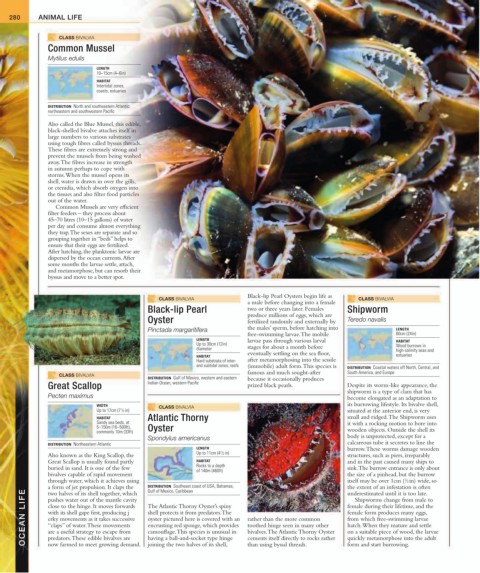
               Also called the Blue Mussel, this edible,
               black-shelled bivalve attaches itself in
               large numbers to various substrates
               using tough fibres called byssus threads.
               These fibres are extremely strong and
               prevent the mussels from being washed
               away. The fibres increase in strength
               in autumn perhaps to cope with
               storms. When the mussel opens its
               shell, water is drawn in over the gills,
               or ctenidia, which absorb oxygen into
               the tissues and also filter food particles
               out of the water.
                 Common Mussels are very efficient
               filter feeders – they process about
               45–70 litres (10–15 gallons) of water
               per day and consume almost everything
               they trap. The sexes are separate and so
               grouping together in “beds” helps to
               ensure that their eggs are fertilized.
               After hatching, the planktonic larvae are
               dispersed by the ocean currents. After
               some months the larvae settle, attach,
               and metamorphose, but can resorb their
               byssus and move to a better spot.


                                                                           Black-lip Pearl Oysters begin life as
                                                CLASS BIVALVIA                                              CLASS BIVALVIA
                                                                           a male before changing into a female
                                             Black-lip Pearl               two or three years later. Females   Shipworm
                                             Oyster                        produce millions of eggs, which are   Teredo navalis
                                                                           fertilized randomly and externally by
                                                                           the males’ sperm, before hatching into      LENGTH
                                             Pinctada margaritifera
                                                                           free-swimming larvae. The mobile            60cm (24in)
                                                           LENGTH          larvae pass through various larval          HABITAT
                                                           Up to 30cm (12in)                                           Wood burrows in
                                                           diameter        stages for about a month before             high-salinity seas and
                                                                           eventually settling on the sea floor,
                                                           HABITAT                                                     estuaries
                                                           Hard substrata of inter-   after metamorphosing into the sessile
                                                           and subtidal zones; reefs   (immobile) adult form. This species is   DISTRIBUTION  Coastal waters off North, Central, and
                                                                           famous and much sought-after   South America, and Europe
                  CLASS BIVALVIA
                                             DISTRIBUTION  Gulf of Mexico, western and eastern   because it occasionally produces
               Great Scallop                 Indian Ocean, western Pacific  prized black pearls.         Despite its worm-like appearance, the
                                                                                                        shipworm is a type of clam that has
                                                                                                        become elongated as an adaptation to
               Pecten maximus
                              WIDTH             CLASS BIVALVIA                                          its burrowing lifestyle. Its bivalve shell,
                              Up to 17cm (7 1 / 2 in)                                                   situated at the anterior end, is very
                              HABITAT        Atlantic Thorny                                            small and ridged. The Shipworm uses
                              Sandy sea beds, at                                                        it with a rocking motion to bore into
                              5–150m (16–500ft),   Oyster
                              commonly 10m (33ft)                                                       wooden objects. Outside the shell its
                                                                                                        body is unprotected, except for a
                                             Spondylus americanus
               DISTRIBUTION  Northeastern Atlantic                                                      calcareous tube it secretes to line the
                                                           LENGTH                                       burrow. These worms damage wooden
                                                                   1
                                                           Up to 11cm (4 / 2 in)
               Also known as the King Scallop, the                                                      structures, such as piers, irreparably
               Great Scallop is usually found partly       HABITAT                                      and in the past caused many ships to
                                                           Rocks to a depth
               buried in sand. It is one of the few        of 140m (460ft)                              sink. The burrow entrance is only about
               bivalves capable of rapid movement                                                       the size of a pinhead, but the burrow
                                                                                                                         1
               through water, which it achieves using                                                   itself may be over 1cm (/2 in) wide, so
               a form of jet propulsion. It claps the   DISTRIBUTION  Southeast coast of USA, Bahamas,   the extent of an infestation is often
        OCEAN LIFE  close to the hinge. It moves forwards   The Atlantic Thorny Oyster’s spiny   toothed hinge seen in many other   female during their lifetime, and the
                                             Gulf of Mexico, Caribbean
               two halves of its shell together, which
                                                                                                        underestimated until it is too late.
                                                                                                           Shipworms change from male to
               pushes water out of the mantle cavity
                                             shell protects it from predators.The
                                                                                                        female form produces many eggs,
               with its shell gape first, producing j
                                                                                                        from which free-swimming larvae
                                             oyster pictured here is covered with an  rather than the more common
               erky movements as it takes successive
                                                                                                        hatch. When they mature and settle
                                             encrusting red sponge, which provides
               “claps” of water. These movements
                                             camouflage. This species is unusual in
                                                                           bivalves. The Atlantic Thorny Oyster
               are a useful strategy to escape from
                                                                                                        on a suitable piece of wood, the larvae
                                                                                                        quickly metamorphose into the adult
                                                                           cements itself directly to rocks rather
               predators. These edible bivalves are
                                             having a ball-and-socket type hinge
               now farmed to meet growing demand.  joining the two halves of its shell,
                                                                           than using byssal threads.
                                                                                                        form and start burrowing.
   277   278   279   280   281   282   283   284   285   286   287